(English below)
Un jalon majeur a été franchi la semaine dernière : la plateforme RDCore dispose désormais d’un interpréteur qui assemble toutes les pièces du puzzle en quelque chose de traçable, configurable et extensible, qui ressemble aux débuts d’un runtime.
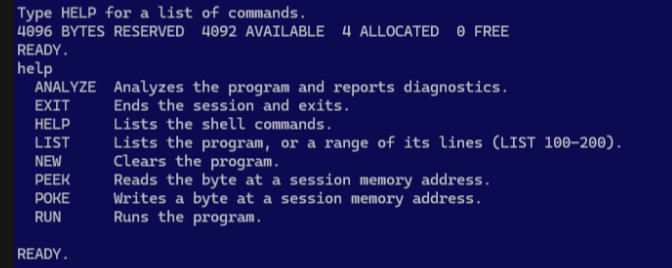
Là où tout ceci devient très concret : l’application console exécute maintenant une boucle REPL interactive où vous exécutez une session runtime en mode immédiat :
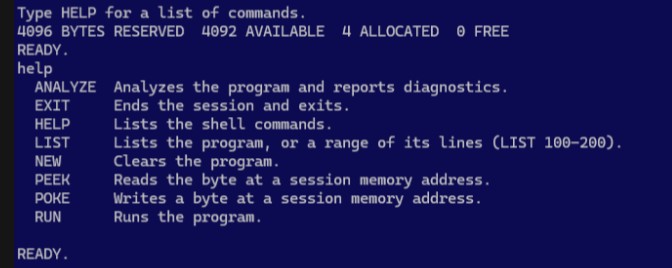
Les 4 octets alloués sont pris par le module et la procédure synthétique où vit le code source de votre programme. Tapez une instruction VBA, elle s’évalue et affiche son résultat; précédez-la d’un numéro de ligne, et vous venez d’inscrire cette instruction à cette ligne dans votre programme RD-VBA. Le nom de ce module synthétique est Program, et le nom de la procédure est Main. Vous verrez régulièrement ces identifiants dans les traces de la pile d’exécution (stack trace) des erreurs rencontrées – qui seront ici toujours sous Main, mais vous comprendrez que ce même mécanisme fonctionnera peu importe la profondeur de la pile dans un véritable client (IDE), avec un vrai projet et plusieurs modules et procédures.
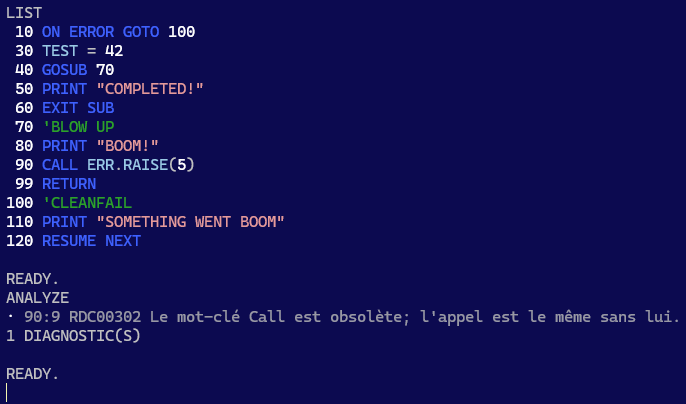
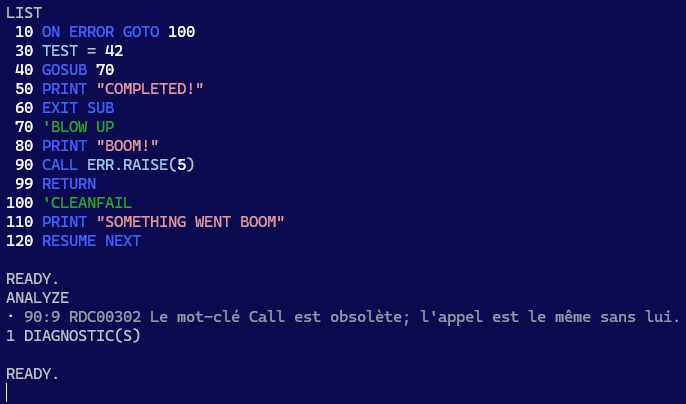
L’idée ici n’est pas de faire évoluer cette application en un IDE non plus – mais ça fait une façon très divertissante de tester la plateforme, le cœur de langage et ses sémantiques. Le rôle de cette application est de simplement permettre de tester la plateforme de bout en bout. Étant un client LSP, nous verrons fort probablement apparaître un surlignage sémantique de la syntaxe au niveau de la sortie de LIST par exemple, ou alors des listes de complétion interactives; les diagnostics sont déjà branchés et ANALYZE en affichera les détails dès que ceux-ci deviendront disponibles. PEEK/POKE ne sont que pure lecture/écriture directe en mémoire à la Commodore64.
RUN exécute le programme de haut en bas, à moins que vous lui construisiez un parcours avec GoTo et GoSub/Return, auquel cas vous savez probablement ce que vous faites… sinon les diagnostics seront bientôt là pour vous guider.
Sémantiques
Toute la plomberie est en place; ce qu’il reste, c’est l’implémentation : les instructions I/O comme Open, Close, Print#, Write#, Put#, Get# sont implémentées; les déclarations, boucles, conditions, sauts et gestion d’erreurs sont fonctionnels. Beaucoup reste à faire: chacune des instructions doit avoir une implémentation, sans quoi les exécuter sera toujours en erreur.
L’implémentation de la librairie standard a débuté : Len et LenB sont les premiers consommateurs des données de stockage des UDT, et bien que LSet fonctionne tel que spécifié sur une String ou un UDT, la très vaste majorité de la librairie demeure à implémenter. Il s’agit de travail relativement simple qui n’a pas à traverser plusieurs couches d’abstraction et peuvent être des gains rapides; c’est pourquoi j’ai préféré donner les plus gros morceaux à Claude, les fonctions pures de la librairie peuvent être implémentées plus tard.
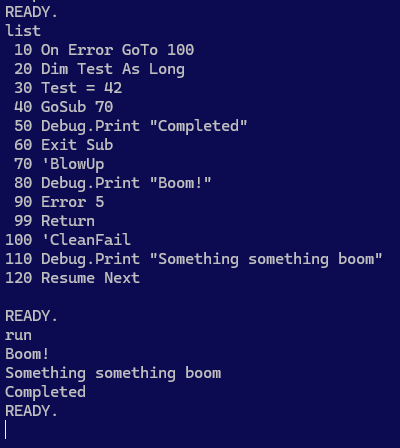
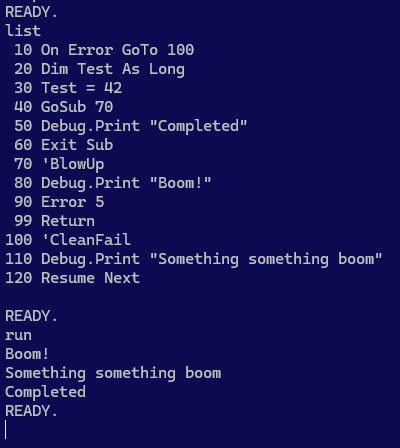
Ceci dit l’exécution et la gestion d’erreurs en place donnent déjà un bon aperçu :
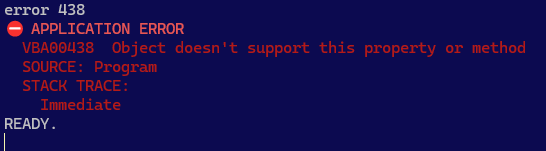
Le retrait de l’instruction On Error GoTo révèle quelques faits intéressants :
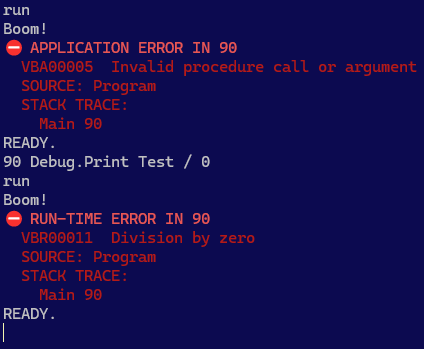
Ce que ces images ne montrent pas, c’est que le numéro de ligne est un symbole ici, seulement parce qu’il s’agit du mode programme – mais dans un document, la configuration par défaut fait de ce numéro l’emplacement L1C1 exact de l’erreur dans le document.
Une erreur d’application (VBA00000) est une erreur lancée par le code source (via Error, ou Err.Raise); une erreur d’exécution (VBR00000) est une erreur lancée par l’interpréteur. MS-VBA ne différencie pas réellement ces deux types d’erreurs – il y a donc désormais une distinction claire entre les deux, et ça ne brise rien du tout!
Limitations
Certaines limitations sont inhérentes au fait qu’il s’agisse d’une application console: en effet il serait surprenant d’y voir une fonctionnalité affichant des info-bulles au survol d’un symbole.
D’autres limitations sont plutôt liées au design:
- Le module Program et la procédure Main sont intrinsèques et ne peuvent pas être renommés.
- Une commande sans numéro de ligne s’exécute immédiatement; les numéros de ligne sont donc obligatoires pour tout programme dans ce client.
- Les numéros de lignes ne devraient pas empêcher l’utilisation de libellés, mais ceux-ci ne fonctionnent pas actuellement avec un numéro de ligne; GoTo/GoSub doivent donc référer à un numéro de ligne.
- Les continuations sont invalides: un numéro de ligne ne peut pas être situé en plein milieu d’une instruction.
- Limitation éventuelle du jeu de syntaxe valide en mode BASIC (configurable).
- Limitation éventuelle à 10,000 lignes de la longueur permise d’une procédure; l’erreur procedure too long devrait alors être lancée à la compilation, mais possible que le mode BASIC fonctionne différemment.
- Exit Sub termine le programme; Exit Function et Exit Property sont statiquement invalides.
- Sub Main() et End Sub sont implicites: le corps du programme constitue le corps de cette procédure.
- L’ajout de procédures additionnelles n’est pas supporté (les numéros de ligne étant invalides au niveau des déclarations d’un module); utilisez plutôt GoSub/Return avec de larges sauts de numérotation pour coder des sous-routines.
D’autres limitations sont ponctuelles et seront résolues avant le lancement de la v1 :
- L’instruction REM qui explose à l’exécution est objectivement comique, mais ne restera vraisemblablement pas brisée longtemps.
- L’invocation de membres de la librairie standard qui ne sont pas encore implémentés sera également en erreur.
Manipulation de Mémoire
Les commandes PEEK et POKE ne sont pas (encore?) implémentées en tant que mots-clés et donc pas utilisables dans du code source RD-VBA, mais les commandes fonctionnent et permettent donc une lecture/écriture directe d’octets en mémoire applicative – opération évidemment très risquée, mais la nostalgie l’a emportée.
Ceci dit les opérations LSet fonctionnent dans le code source sur des String et UDT.
Jalons
L’évolution du cœur de langage est complètement découplée de celle de l’application CLI, donc celle-ci fonctionnera de mieux en mieux et de façon de plus en plus complète à mesure que s’ajouteront les sémantiques du cœur de langage, et ce sans rien devoir corriger ou modifier dans l’application même.
Cela ne signifie pas pour autant que le travail est terminé!
L’application supporte notamment des thèmes, donc si le bleu C64-BASIC ne vous plaît pas, vous pouvez toujours passer à un thème foncé moderne. Ce n’est donc qu’une question de temps avant que la sortie de LIST affiche un surlignage sémantique issu du serveur de langage!
Exploiter cette connexion LSP constitue la façon dont cette application deviendra ultimement beaucoup plus qu’un éditeur BASIC. ANALYZE est déjà prêt à afficher les diagnostics, dès qu’ils commenceront à apparaître dans la plateforme.
Le mode REPL est bien pour une démo, mais le véritable outil est le mode CLI non interactif.
Les outils modernes s’exécutent dans des pipelines CI/CD (intégration et livraison continues) dans le cloud. rdc.exe sera à terme en mesure de compiler un projet, d’en exécuter les tests, et de bloquer une livraison qui dévie des conventions établies, le tout complètement en-dehors de l’écosystème MS-VBA.
Êtes-vous READY?
Mise à jour | Update 2026-10-02:
English
If only 1986 had LSP…
A major milestone was knocked down in the last week: the RDCore platform now has an interpreter that puts all the previous pieces together into a traceable, configurable, and extensible beginning of a runtime.
Where this gets very real, is with the CLI app now running an interactive REPL program mode where you’re basically running a runtime session in immediate mode:
The 4 bytes taken are allocated for the synthesized module and procedure scope your program space lives in. Type a VBA expression, and you get its result; precede it with a line number, and now you’ve written that instruction at that specified line number in your program. The name of this synthesized module is Program, and the name of the enclosing procedure is Main. This matters, because you’ll see these identifiers in error stack traces – here only ever inside Main, but you can see what this means for error handling with an actual IDE client, and a project with real procedure scopes.
The idea is not to evolve this app into one, either; it’s just to make a fun way to test the language core and semantics… and diagnostics – the platform, basically. The role of RD-VBA CLI mode is to test the platform end-to-end, hands-on – and being a LSP client means we’ll probably get to write old-school BASIC programs with semantic syntax highlighting in LIST outputs, completion lists for the REPL inputs. Diagnostics are already wired, ANALYZE will start showing meaningful output when providers/extensions issue diagnostics. PEEK/POKE is just C64-like pure unsafe program memory read/write.
RUN runs the program top to bottom, unless you make it do funny things like GoSub, in which case you probably know what you’re doing. If you don’t, …RDCore diagnostics will eventually have your back covered.
Semantics
So the plumbing is in place; what remains is semantics: file I/O statements like Open, Write, Print#, are implemented at the language core layer. Declarations, control flow, error handling as well. Still a lot remains TODO – every single statement keyword must have its semantics implemented, otherwise running them gets you an internal error.
Standard library implementation has begun as well; Len and LenB are the first consumers of the UDT member storage data, and while all the symbols are defined and LSet works as specified on UDT and strings, the vast majority of the standard library remains to be implemented; this is mechanical work that doesn’t need to reach across multiple layers to be a quick gain – so I let Claude/Opus focus on the more meaty parts that do cross into the runtime and memory layout, leaving the simpler, pure functions for later.
Control flow and error handling is fully functional:
Removing the On Error GoTo instruction reveals a number of interesting facts about RD-VBA:
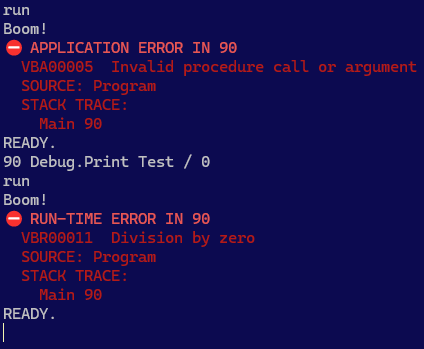
What this doesn’t tell you, is that the platform is showing symbolic line numbers here only because it has no workspace document proper (the internal buffer just simulates one), but in an IDE client the default configuration would be reporting the actual L1C1 document location.
An application error (“VBA00000”) is a run-time error that is raised by the workspace code; a runtime error (“VBR00000”) is a run-time error that is raised in the language core runtime semantics. MS-VBA historically did not really differentiate between these errors; now there’s a structural distinction between them, and it doesn’t break anything!
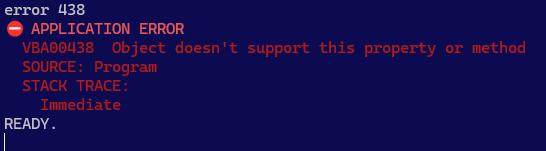
Limitations
Some limitations are inherent to the CLI app being a CLI app: hover tooltips aren’t going to be available, and that’s a given.
Others are design decisions. These include:
- Program.Main project and procedure scope; intrinsic, cannot be renamed.
- C64-style program interface, using line numbers as markers for instructions that are stored in the source buffer rather than immediately piped to the interpreter; this makes line numbers inherently mandatory in this client.
- Line numbers should not prevent the use of line labels, however labels do not currently parse with line numbers. GoTo must therefore refer to line numbers.
- Line continuations cannot be used; a line number isn’t a valid statement to continue into.
- Eventually artificially limiting the valid RD-VBA syntax (including comments) in CLI program mode to the BASIC subset of VB, via appsettings.json platform configuration.
- Eventually limiting the number of logical lines to 10,000; procedure too long compile-time error ought to be raised then, but BASIC mode will probably end up working differently.
- Exit Sub terminates the program; Exit Function and Exit Property are statically illegal.
- Sub Main() and End Sub are implicit; the program body is that procedure’s body.
- Additional Sub procedures cannot be defined (line numbers are illegal on declaration members); use GoSub/Return with wide line numbering gaps to denote subroutines instead.
Other limitations are temporary pre-alpha missing implementations that will definitely be implemented before a v1.0 can ship:
- REM statements (BASIC-style comments) throwing statement not implemented is objectively funny, but will probably not take too long to get working as the no-op instruction it is.
- Standard library implementation being incomplete, any function call that refers to a symbol defined there throws not implemented as well.
Unsafe Program Memory Ops
Not (yet?) implemented as keywords, the PEEK and POKE immediate commands allow byte-level unsafe reads and writes (!) from/to a specified address in program memory space. This is obviously dangerous and may lead to crashes, but nostalgia won.
That said LSet and RSet semantics are both implemented, including against UDT values.
🎯 Milestones
The evolution of the RD-VBA language core and runtime implementation is architecturally decoupled from the CLI application, so it’ll automatically throw fewer errors as the language core progresses, without fixing or changing anything anywhere in the CLI app.
That doesn’t mean the work is done, however.
The app supports themes, so if you don’t like C64-style BASIC blue, you might like a modern dark theme instead. It’s only a matter of time before LIST output gets semantic syntax highlighting from the language server!
Leveraging this LSP connection is how the app will turn into something more than a BASIC console. ANALYZE is already wired up to report diagnostics as soon as they start coming.
A BASIC immediate/command/program mode is nice for a platform demo, but the real tool is the non-interactive CLI mode.
Modern tools run in the cloud, from CI/CD scripts that build a project, run its tests, inspect its vulnerabilities and deviations from established coding practices; rdc.exe supports an extensible set of command-line tools exactly for this. Extensions can supply a provider for various commands such as test or analyze, and a CI/CD script could be configured to gate a build on tests passing and diagnostics showing no warnings or errors.
Are you READY?