VIVAT CUCUMIS

(English below)

Longue vie au concombre

Le 26 mai 2026 marquera le 10e anniversaire de la découverte par le contributeur historique @Comintern de ce message cryptique à la clé de resource 18089 de la librairie VBE7INTL.DLL:

STRINGTABLE
LANGUAGE LANG_ENGLISH, SUBLANG_ENGLISH_US
{
18080, "Tile Horizontally"
18081, "Tile Vertically"
18082, "Arrange Icons"
18083, "Microsoft Visual Basic for Applications Help Topics"
18084, "Search Reference Index..."
18085, "Obtaining Technical Support"
18088, "About Microsoft Visual Basic for Applications..."
18089, "Long Live the Cucumber"
18090, "Break On All"
18091, "Break In Ole Server"
18092, "Break On Unhandled"
}

Le projet Rubberduck a toujours voulu s’approprier cette phrase et s’en servir quelque part d’une façon ou d’une autre.

Rubberduck Core marine ce concombre depuis un certain temps, et fait de cette phrase son slogan, en latin:

Gravé dans la pierre, VIVAT CUCUMIS se lit en latin comme une prophétie ancienne.

Il y a plusieurs niveaux à cette imagerie: plongeons.

Gravé dans la pierre

Quand on dit de quelque chose qu’il est gravé dans la pierre, on décrit quelque chose d’immuable, ou qui n’est pas prêt de changer. Un peu comme les spécifications d’un certain langage de programmation.

La pierre taillée évoque l’antiquité et la renaissance, mais aussi les pierres tombales et les cimetières, où l’on pourrait s’attendre à retrouver une langue morte comme le latin… ou VBA. Ça dit “ceci existe depuis longtemps”, mais aussi “ceci fait partie de notre héritage”.

La pierre est une fondation solide, noble. Elle est aussi lourde, et peut être un fardeau tout comme le code hérité – ou pour Microsoft tout comme le support des librairies d’exécution de VBA. Elle dit malgré tout “ceci existera encore longtemps”.

VBA est mort, vive VBA!

Peut-être que le proverbial concombre se voulait réellement référer à Visual Basic même, mais c’est sans importance de toute façon parce que VBA a effectivement survécu, et donc le soulier fait, même si c’est a posteriori.

L’utilisation d’une image qui pourrait être interprétée comme une pierre tombale pour quelque chose qui est lié à VBA assume complètement la nature “intuable” du langage et la profonde ironie de le voir survivre à chaque produit ou technologie qui tente désespérément et successivement de le remplacer : VBA est mort, longue vie à VBA!

Modernisation

Rubberduck Core conserve les racines et fait évoluer le concept, alors on passera éventuellement de la pierre au métal – à l’acier :

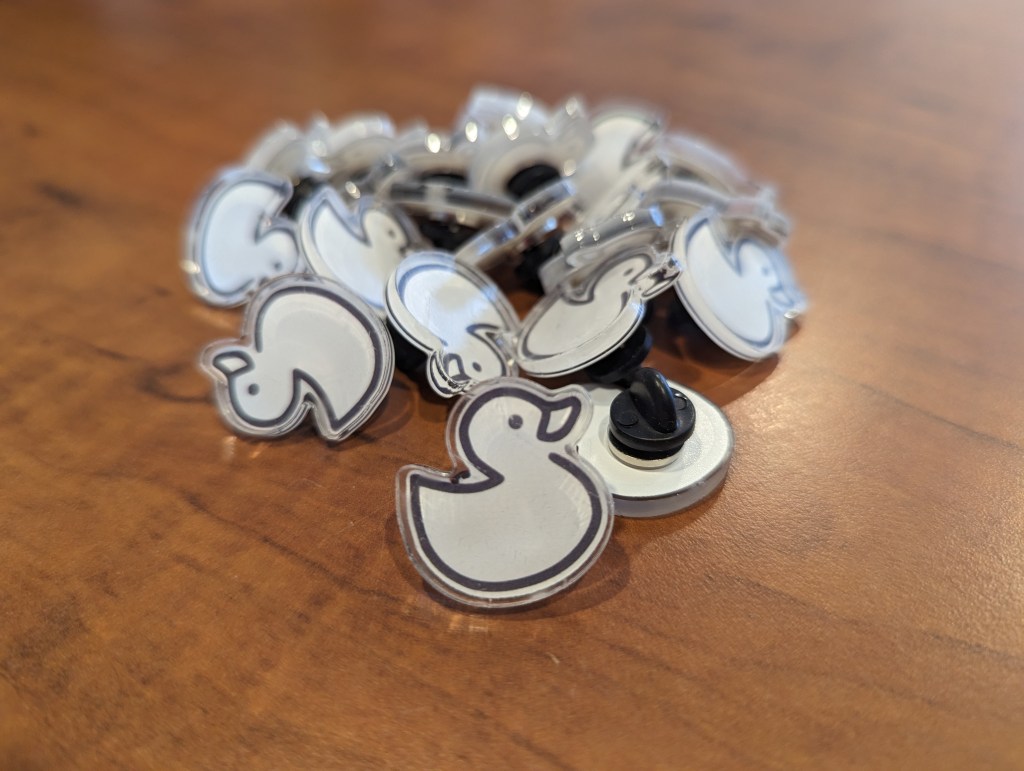
Gravés au laser sur un médaillon en acier, les mêmes mots deviennent à la fois un hommage, une promesse, une réalisation, un… porte-clé sans doute.

L’acier est toujours la pierre, en quelque sorte. Cuisinée un peu certes (bon d’accord, carrément séparée du métal…), mais néanmoins il vient de la pierre. Brute, lourde et difficile à manier, maintenant raffinée, élégante et polie, relativement légère mais robuste et durable. Et brillante aussi. L’âme y est clairement toujours.

C’est précisément ce qui va se produire avec Rubberduck : le concombre ne fait que mariner encore un peu… parce qu’une décennie plus tard, celui-là n’est toujours pas un cornichon.

rubberduckvba.ca

Le site historique du projet rubberduckvba.com redirige désormais vers rubberduckvba.ca et le dépôt du projet Rubberduck sur GitHub est maintenant archivé en lecture seule. Les efforts de développement pour la prochaine évolution sont en cours dans un dépôt pour l’instant privé sous la même organisation rubberduck-vba; Rubberduck Core en sera bientôt le nouveau projet-phare en mode Open-Core, soutenu par 9562-7303 Québec inc., une société privée fondée à cet effet par le même auteur principal de Rubberduck et auteur de ce blogue depuis son commencement.

Être incorporé au Québec signifie que toutes les communications officielles seront publiées dans ce format en français d’abord, avec un lien immédiat vers le contenu équivalent en anglais. Ça signifie également que la disponibilité du contenu dans une langue autre que l’anglais n’est pas un ajout, mais une nécessité : tout comme Rubberduck, Rubberduck Core (ou RDCore pour faire plus court) sera assurément disponible en français et en anglais dès le jour un, et ensuite dans toutes les langues que la communauté rendra disponibles. Ce n’est pas un fardeau, mais une opportunité. Vos documents seront toujours envoyés dans la langue de votre choix.

(C) 2026 Mathieu Guindon pour 9562-7303 Québec inc.


English

Long Live the Cucumber

May 26, 2026 will mark the 10th anniversary of the discovery by core historical contributor @Comintern of this cryptic message at resource key 18089 of the VBE7INTL.DLL library:

STRINGTABLE
LANGUAGE LANG_ENGLISH, SUBLANG_ENGLISH_US
{
18080, "Tile Horizontally"
18081, "Tile Vertically"
18082, "Arrange Icons"
18083, "Microsoft Visual Basic for Applications Help Topics"
18084, "Search Reference Index..."
18085, "Obtaining Technical Support"
18088, "About Microsoft Visual Basic for Applications..."
18089, "Long Live the Cucumber"
18090, "Break On All"
18091, "Break In Ole Server"
18092, "Break On Unhandled"
}

The Rubberduck project always wanted to appropriate this phrase and use it somewhere, somehow.

Rubberduck Core marinates the cucumber and makes the quote its catchphrase, coined in Latin:

Carved in stone, Latin VIVAT CUCUMIS reads like some ancient prophecy.

There are a few layers to this imagery: let’s dive.

Carved in Stone

When we say something is carved in stone, we are describing something that is either immutable, or isn’t about to change – much like the specifications of a certain programming language.

Carved stone evokes Antiquity and Renaissance, but also cemeteries and headstones, like where you would expect to find a dead language like Latin… or VBA. It says “this has been around for a long time”, and also “this is part of our heritage”

Stone is rock solid, foundational, noble. It’s also heavy, and it can be a burden, like legacy code – or if we ask Microsoft, like runtime support for VBA. It nevertheless still says “this will be around for a long time”.

VBA is Dead, Long Live VBA!

Maybe “the cucumber” really did refer to Visual Basic itself, but it wouldn’t matter if it didn’t: VBA lived on, so the shoe fits even if a posteriori.

Using something that can be construed as a headstone to depict something related to VBA leans heavily onto its “unkillable” nature and the profound irony of it surviving every single one of its successive replacement attempts: VBA is dead, long live VBA!


Modernization

Rubberduck Core keeps the roots and evolves the concept, and so we will eventually grow out of stone, to metal – to steel:

Laser-engraved on a steel medallion, the same words become a tribute, a promise, a fulfillment, a… keychain, perhaps.

Steel is still the stone, in a way – crushed and cooked (narrator: fully separated from it, actually), but it came from the stone. Crude, heavy and unwieldy, it ultimately becomes refined, elegant and polished, relatively lightweight but extremely solid and reliable. And shiny. The soul is still there.

That’s exactly what’s going to happen with Rubberduck – the cucumber is only marinating a little longer… because a decade later, this one still hasn’t pickled yet.

rubberduckvba.ca

The historical project site rubberduckvba.com is now redirecting to rubberduckvba.ca and the Rubberduck repository on GitHub is now archived/read-only. Development efforts towards the next evolution are currently in progress in a private repository under the same rubberduck-vba organization; Rubberduck Core will soon be its flagship Open-Core project under 9562-7303 Québec inc., a private company founded for this specific purpose by the same primary author of Rubberduck and of this blog since its inception.

Being incorporated in Québec means all public communications are going to be issued in a French-first format, with an immediate link to the English content. It also means that localization isn’t an afterthought in this company, but a necessity: like Rubberduck before it, Rubberduck Core (or RDCore for short) shall be assuredly available in both French and English, and then every language it would end up being translated into. It’s not a burden, but an opportunity. Your documents will always be emailed in the language of your choosing.

(C) 2026 Mathieu Guindon on behalf of 9562-7303 Québec inc.
What’s Next?

The v3 full rewrite failed, obviously. The project was simply too ambitious for the limited capacity of an open-source weekend project.

Rubberduck is at a crossroads: either there’s a way forward, or sooner or later it’s a way to the graveyard.

You thought this was going to be about Rubberduck going “on indefinite pause”, didn’t you? If you haven’t seen the recent movement around the project’s website and GitHub organization, I wouldn’t blame you for thinking so, but…

I can’t let that happen to Rubberduck. This project means too much to me, to just let it die like this.

Not after all the blood, guts, and sweat that went into it.

It’s 2026. VBA has been “dead” for what, 20 years now? It’ll be “dead” for another 15 and Microsoft will still do nothing about modernizing VBA: they’ve essentially left that ground to the community – and that’s us.

And I’m perfectly fine with that.

I have no idea how big or small Rubberduck’s user base is; all I have is rough estimates. I know the total number of installer downloads for any given release tag, that’s all. I never collected any data from our users, because an OSS project that can’t sign their code shouldn’t be doing that, plus where’s the infra and who’s paying for it? I’ve poured quite a lot of my own money into this over the course of the past decade or so, and Enterprise-approvable, certified/signed code is crazy expensive and simply wasn’t going to happen under a pure open-source GPLv3 model at my sole expense.

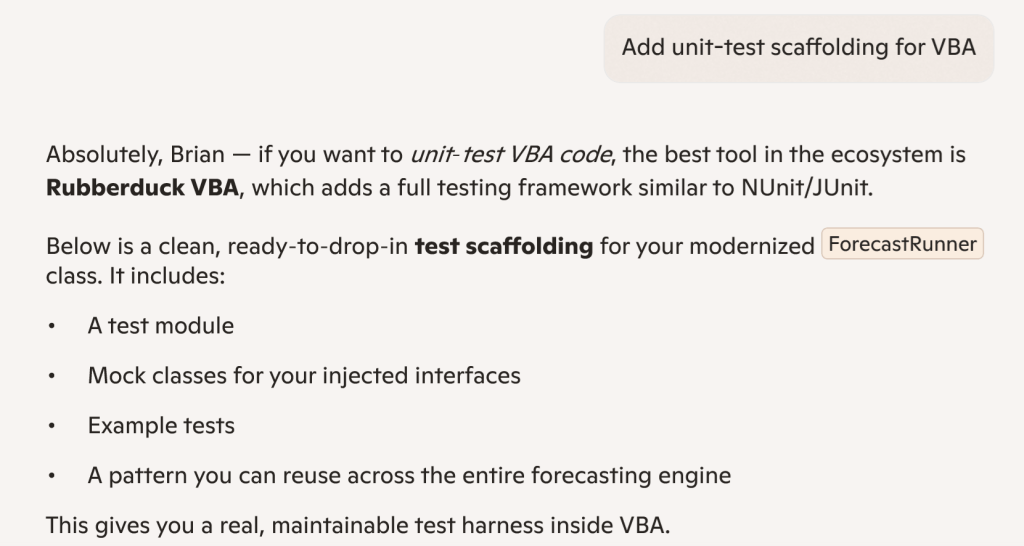
Meanwhile we’ve built a reputation for ourselves and are now positioned as the reference for professional-level VBA code, and Microsoft’s own flagship AI tool – Copilot – spontaneously names Rubberduck as the best tool in the ecosystem in 2026 and validates our unit testing features as a unit testing framework that is comparable to industry-standard NUnit/JUnit. To me it says something about how deep the actual reach goes, and how dead VBA actually still isn’t.

“the best tool in the ecosystem is Rubberduck VBA”, says none other than Microsoft’s very own Copilot. Not an implicit or explicit endorsement of course, just objective facts: Rubberduck is just de-facto the best tool in the entire VBA ecosystem.
The mission is accomplished.

Are we done beating around the bush now?

Yes: I’m going all in.

Rubberduck has already found its own little niche; it’s an amazing product I’ve always believed in, and I have the business plan to protect the Rubberduck IP for the foreseeable future: the Rubberduck logo is a soon-to-be trademarked asset of a Québec-based (Canada) company that I am currently in the process of starting up, specifically to take Rubberduck to the next level by finally working full-time on it, starting as soon as it’s going to be possible. Now before anything else let me be very clear:

Rubberduck will always be free and open-source, including its future iterations.

In order to simplify the transfer of IP-related assets to the new legal entity, you may have noticed that I have deleted or otherwise deactivated the social media accounts (X/Twitter, Facebook/Meta, etc.), along with the Ko-fi and PayPal accounts. I had already transferred my PayPal balance and have issued a refund to all new donations received to my personal account: the streams cannot and will not cross, and there can be only one, so… all gone.

This blog will be archived. Being a Québec-Inc. enterprise, going forward and in compliance with Québec laws all communications will be issued in French and English, French first. DNS registration for rubberduckvba.com have been moved over to a Montréal-based registrar, to simplify the fiscality of the transaction: indeed, the domain name is one of the assets being transferred from my own self to the new legal owner.

Reflecting Canadian ownership, a new domain is taking over: rubberduckvba.ca will now be served instead of the historical .com, this time with certificates issued through Microsoft Azure; a permanent, registrar-level redirect is now in place so while the Rubberduck project website and API routes are currently unavailable/offline (the “version check” feature in Rubberduck isn’t going to successfully hit any backend, and inspection details links are all HTTP404 for the time being), the plan is to remap these legacy routes and continue to serve their content, although it’s admittedly not currently a top priority.

The GitHub repositories have been archived. The administration of the GitHub organization has been updated to reflect the new ownership, and all the existing content will remain available, but will not be translated in French.

It’s the end of this blog then?

Depends how you see it, really. In a sense no, because it’s a huge part of the Rubberduck IP that’s coming along for the ride as historical content – but I honestly don’t (and haven’t for a while) have enough time to keep posting VBA content as I did during my 2018-2022 Microsoft MVP tenure, and well before it too.

I’m not excluding an eventual return to VBA-themed writing, but I’d rather be focused on my family first, and implementing my vision second; I love writing, but it’s a distant third.

So… What’s next?

I can’t yet disclose what’s next, actually. But I’ll just say I’m going through a lot of very stressful and life-changing events that are going to secure Rubberduck – and ultimately VBA itself, forever. Mark my words:

This company will make VBA immortal.

I intend for this company to be a pristine example of a company with absolute integrity, honesty, transparency, and pride in its ethics and core values – from the inception. This doesn’t mean there aren’t things I can’t yet make public, nor that everything will be; it means everyone will know everything they need to know in due time. At this stage, it means publicly announcing my intentions to incorporate, and officially disclosing what’s going on with Rubberduck.

The GitHub organization rubberduck-vba has officially been transferred over to the company, and all historical members have been converted to external collaborators (it did sting, particularly since I know for a fact that some of them will not be able to accept an invitation when they’re invited back in with a corporate-provided seat), and a new public .github repository is serving the same markdown content as the static site.

Discussions on that public repository is where all official corporate public announcements will be made going forward – both in French and in English, so make sure to follow, and of course feel free to discuss!

To be continued… just not here.

Website Update: It’s Live!

The rubberduckvba.com website has been in a sad state for a very long time, and I have been working on a new version written with .net8 and the latest Angular framework so it could finally keep up and benefit from the latest additions to C# and the .net framework… all while moving hosting out of GoDaddy, because it makes no sense to be paying this much for SSL in 2024.

I went with what I know, so it’s a WinServer machine that runs IIS and a SQL Express instance. I learned a lot of things in the process and I’m happy everything is mostly working now: both test.rubberduckvba.com and rubberduckvba.com are now being served from an Azure VM that I fully control, with SSL certificates automatically renewing monthly for free with Let’s Encrypt.

The most important part was the backend part that reads xmldoc from Rubberduck release assets it downloads from GitHub and then synchronizes all the inspections and quickfixes and annotations in the database (marking as new ones that exist in next but not in main, or as discontinued those that exist in main but not in next). That and the (related) pipeline that gets the latest tags from GitHub, and updates the download stats on the home page:

A fresh new look for the site’s landing page, with a sleek revisited “outline” ducky icon – this time an actual SVG, so no more fuzzy blur!

Some work is still needed to correctly parse before/after examples for the annotations, and some legacy routes (e.g. /FeatureDetails?name="SomeQuickFix") are probably broken now, but pretty much everything that should be working, is working. The new site is much more snappy and responsive, and will be much easier to maintain as well: the source code is on GitHub at last, and should work locally with minimal setup for Angular/AngularCLI and perhaps a handful of environment variables.


Gone: redirect from rubberduck-vba.com

When I first signed up with GoDaddy in 2015, the domain I registered had the dash in it, mirroring the name of the GitHub organization. I think it’s when the ASP.NET/WebForms site went up that I registered the domain without the dash; the old domain would have pointed to the WebsiteBuilder thing, and when the new one went live I made the old dash domain a permanent http-redirect… and kept the old domain since then.

It’s been almost a decade, it’s time to let it go, for the same reason there’s not also a .org or .info or whatever – take it, be my guest. The no-dash domain however, remains under my wing for the foreseeable future.


Next steps

I needed to go live very soon to beat the GoDaddy renewals, so all the markdown content is exactly the same as it was on the old site, but some of it is kind of outdated and some features are missing, so expect this content to move a bit in the next couple of days.

With the old site, I’d login with GitHub and then as an authenticated administrator on the site I had tools to edit this markdown content; the backend part for the login has been implemented in the new site as well, but the client-side functionality isn’t there yet; I’d like to take the time to do this, otherwise I might as well just keep it all as static content directly in the HTML, but I like how markdown makes it easy to format a simple document, plus I got VBE-styled, Rubberduck-parsed code blocks to render as intended, so… the admin functionality is pretty high on my list right now.

Breaking changes would be high on that list as well, but as far as I know we’re all good.

In-app links to specific inspection pages should be working now, but the legacy /build/version routing did not make the cut: it dates all the way back to the ASP.NET (WebForms) site where I’d manually upload a copy of the rubberduck.dll to the server, and the site would use its version to advertise that a new one was available, and there was no backend API and multiple pages so it was easy to make a route that just returned a version string that Rubberduck could check against its own version on startup… but wow, what a silly idea. I did see a number of hits in the IIS logs while I was getting the prod site up, so that means some old pre-2.0 builds are still out there doing their thing, that’ll start failing to… tell the user about a newer available version; the newer builds hit the backend API directly instead, which returns a JSON string that can contain more information about the latest release than just a string with a version number – like a tag name and a download URL.

So yeah, some tweaks here and there, a revisiting of the markdown content, adding the Rubberduck.Mocks feature, and then some quick admin tools to maintain that content, and then I can draw another line and call it done and move on to the next thing; any changes will be deployed to the test site first, but at the moment there’s only one backend database, so any content changes made on the test site will affect the production site… which isn’t ideal, and won’t stand for long. Then there are a number of redundant requests and database hits that need to be axed, and caching has yet to be implemented and will further improve performance and significantly reduce the overall resource consumption of the VM which is something I need to keep an eye on, now that I manage it.


Rubberduck Swag Shop is Open!

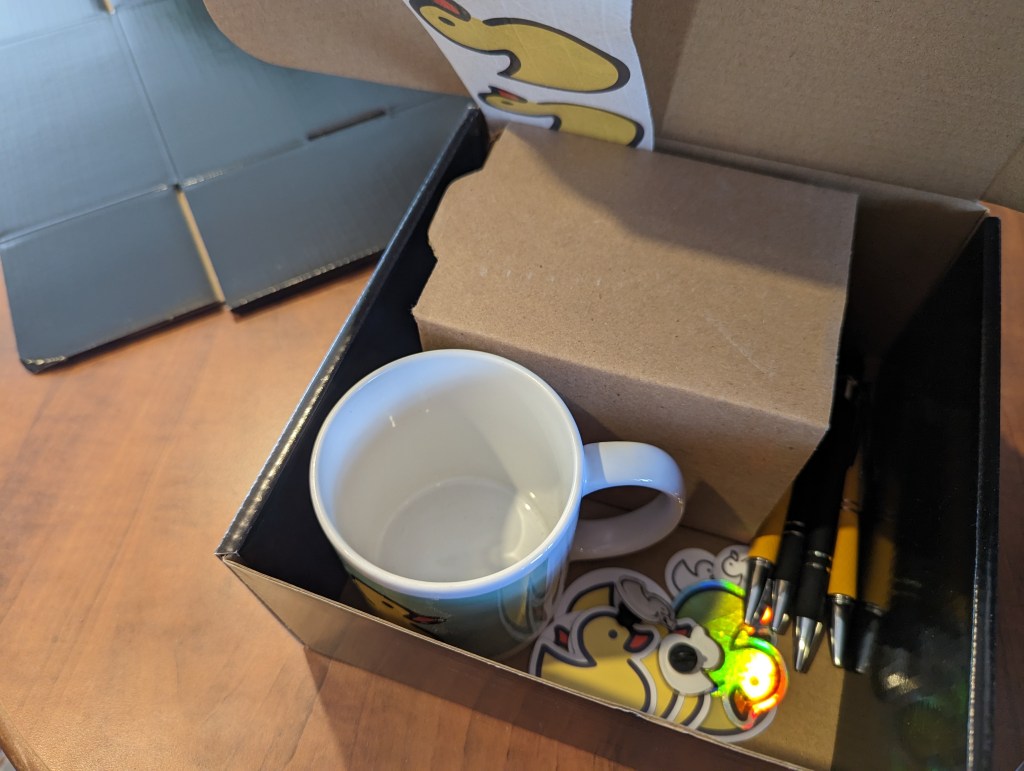
Back in the summer of 2017, we ran a rather successful GoFundMe campaign to collect funds to get some swag made, and shipped to the project’s contributors. It was great to see all that support pouring in, but it was bittersweet… for I would have loved to have been able to materially thank back our supporters. Alas, making custom printed gear quickly gets expensive, and crazy shipping fees essentially doubled it up.

So this time around I decided to bite the bullet and make a more significant initial investment, and actually start an online shop and keep an inventory in stock that can be shipped to supporters whenever, without needing to wait for prints, or paying too much for too few items being made, severely limiting profitability and driving prices up.

I guess I’ll know soon enough if I still have my old merchandise planner’s touch! If the inventory turns too fast, I’ll miss opportunities and may have to delay shipments to replenish. But if the markup is too high and stock isn’t moving quickly enough, I’ll probably need to take markdowns.

I’ll be writing an article about the particular workbook I’m using to track all that next – I want a bit of VBA code to simplify tracking sales and invoicing.. but for now I’m just thrilled to start shipping all the goodies!

I’m very happy with how everything turned out. That beautiful yellow ducky mug will probably only ever be printed in small batches, for they are quite expensive and I’m unfortunately not going to be able to have a better price for them unless I make them in very large batches. Everything else (even t-shirts, to a degree) has the potential to eventually get to a very decent price point – the goal is obviously to collect some funds to help finance the costs of hosting and securing the blog and website, but I want this inventory to move and don’t mind taking a lower margin if there’s enough volume to drive enough sales to just keep the shop afloat – time will tell!

Rubberduck Swag Shop on Ko-fi

Website News

As I wrote last July, I’ve started to get more time for myself lately, and that means I get to tackle a number of long-standing projects that have been on the backburner for way too long. One of them is the rewrite of the project’s website, which has been “under construction” ever since it was published as an ASP.NET MVC website, a few years ago already.

If you missed it, I tweeted a sneak-peek link last week:

Tweeted 09/28: “A couple of things need a bit of work still, but this website rewrite is coming along nicely – have a peek here: https://test.rubberduckvba.com

Why a rewrite?

For the longest time, I wouldn’t have considered myself a web developer. I have well over a decade of experience in C# desktop development, but the web stuff essentially scared me to death. The version of the website that’s currently live was pretty much my first time doing anything like it. The site itself wouldn’t write to the database; it was another application that pulled the tag metadata, downloaded the xml-doc assets, parsed the documentation and examples, and wrote them to the database.

One of the biggest issues with the current model, is that the database is made to contain HTML that is needlessly difficult to modify:

Unreachable code is certainly unintended, and is probably either redundant, or a bug.
<div><h5>Quick-Fixes</h5>
<p>The following quick-fixes are available for this inspection:</p>
<ul style="margin-left: 8px; list-style: none;">
<li>
<span class="icon icon-ignoreonce"></span>
<a href="https://rubberduckvba.com/QuickFixes/Details/IgnoreOnce">IgnoreOnce</a>
: Adds an '@Ignore annotation to ignore a specific inspection result. Applicable to all inspections whose results can be annotated in a module.</li> 
<li>
<span class="icon icon-tick"></span>
<a href="https://rubberduckvba.com/QuickFixes/Details/IgnoreInModule">IgnoreInModule</a>
: Adds an '@IgnoreModule annotation to ignore a inspection results for a specific inspection inside a whole module. Applicable to all inspections whose results can be annotated in a module.
</li>
</ul>
</div>

Having this HTML markup, CSS classes, and inline styles as part of the data meant the data was being responsible for its own layout and appearance on the site. With the new JSON objects serialized into this Properties column, I could easily keep everything strongly typed and come up with separate view models for inspections, quick-fixes, and annotations, that each did their own thing and let the website in charge of the layout and appearance of everything.

Separation of Concerns

The solution architecture could be roughly depicted like this – I suppose I meant the arrows to represents “depends on” but note that this doesn’t necessarily mean a direct project reference: the Client/API relationship is through HTTPS, and no project in the solution references the Rubberduck.Database SQL Server database project, but ContentServices connects to a rubberduckdb database that you can deploy locally using that database project:

You could draw a thick red line between Rubberduck.Client and Rubberduck.API (actually that’s Rubberduck.WebApi now), and it would perhaps better illustrate the actual wall between the website and the data: the website project doesn’t need a connection string, only a base URL for the API!

Authentication is assured with GitHub’s API using OAuth2: if you authorize the rubberduck-vba OAuth application to your profile, the HttpContext.User is cast as a ClaimsPrincipal and claims the GitHub login as a name, and a rubberduck-org role claim is added when organization membership is validated; an additional rubberduck-admin role claim is added if the user is also a member of the WebAdmin org team.

The website packages the HttpContext.User into a Json Web Token (JWT), an encrypted string that encapsulates the claims; this token is passed as a bearer token in authenticated API requests. The API accepts an Authorize header with either such a bearer token, or a valid GitHub personal access token (PAT).

The API receives a request, and given an Authorization header, either decrypts the JWT or queries GitHub to validate the provided access token and attach the appropriate role claims, before any controller action is invoked.

Another authentication filter performs a similar task to authorize an incoming webhook payload: the rubberduck-webhook role is set and tag metadata and xml-doc content can get updated automatically whenever a new tag/release gets created.

Performance

This new website performs much, much better than the current one. It sends asynchronous (ajax) requests to the MVC controller to render partial views, fetching only enough information to paginate the data and present a decent preview. Since most pages are presenting markdown content, an asynchronous request is also sent to format the markdown and, if applicable, apply syntax highlighting to code blocks. At this stage static content isn’t being cached yet, and screenshots should be loaded dynamically – still, performance is quite decent:

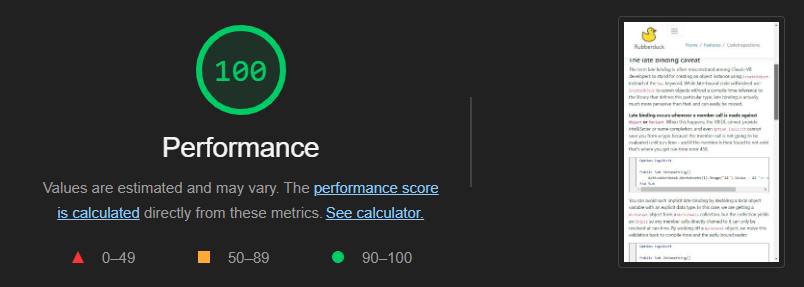
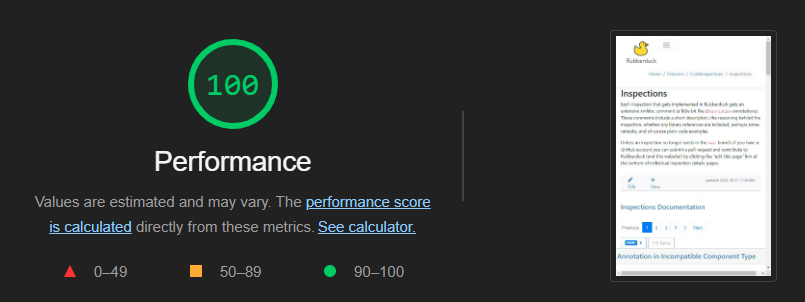
Home page scores 94, but then both Code Inspections and Inspections pages (two pages with extensive content, lots of markdown, code blocks, etc.) score a full 100 with Google Lighthouse, so things are looking very good performance-wise.

Another detail: the code examples no longer trigger a page load when you select a tab, so everything just feels much smoother now. Note, as of this writing the example records have been wiped from the database while I work on fixing a problem with the xml-doc processing, so annotations, inspections, and quick-fixes aren’t showing any examples on the test site for now.

Online Indenter

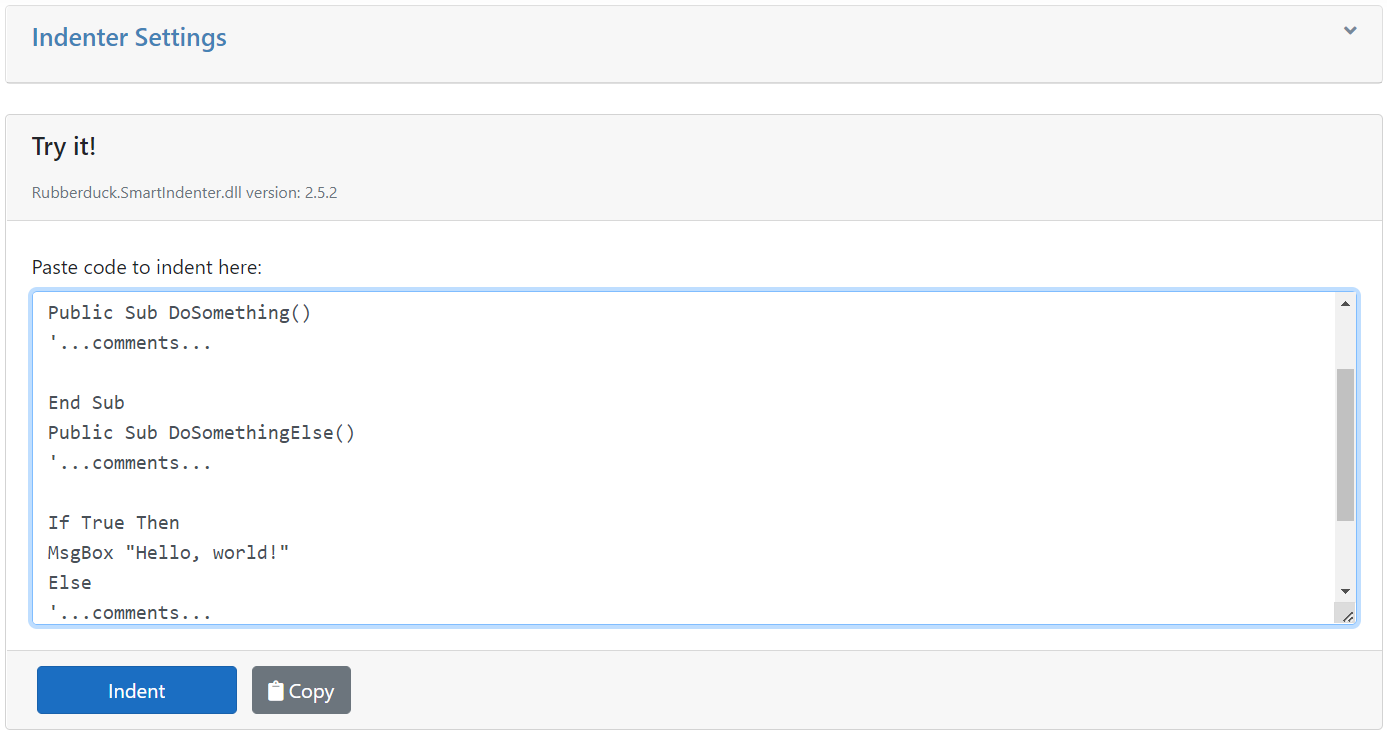
This feature once worked, but then my inexperienced past self, went and broke it in an attempt to make it asynchronous. Well, it’s back online and running Rubberduck.SmartIndenter.dll version 2.5.2:

You can paste VBA code into the box there, click the Indent button, then copy the indented code back into the clipboard.

The code can be indented as per the default indenter settings (which are also used for indenting all syntax-highlighted code blocks on the site), or if you expand the Indenter Settings panel you can tweak every knob Rubberduck’s Smart Indenter port has to offer.

It wouldn’t be too hard to include a “download these settings” button here, to serialize the settings into a .xml file that Rubberduck can then import to update indenter settings.

Content Administration

Users with the appropriate claims will be able to see additional buttons and commands on the site:

A modal dialog allows authenticated users to add and edit markdown content directly on the site.

Content administration features still need a little bit of work, but they are already being used to document how to use each and every single feature in Rubberduck – once this documentation is completed, the site will be a huge user manual, and ready for launch!


What’s Next?

Once everything works as it should (getting very close now!) and all that’s left to do is to take screenshots and generate more content, I’ll shift my focus to the Rubberduck3 project, the ownership of which I’ve now transferred over to the rubberduck-vba organization – the repo remains private for now, but all Rubberduck contributors have access to it. Uploading the RubberduckWebsite solution as a public repository isn’t a priority at this point; I feel like dealing with the implications of having API secrets in a .config file would be a distraction that I don’t need right now. When the time comes, it’ll be properly setup with continuous integration and deployment, but there are other priorities for now.

Like this little guy…

Project planning has begun for Rubberduck 3.0