Bubbly Run-Time Errors

300 feet below the surface, in a sunken wreck from another age, a rotting wooden deck silently collapses under the weight of heavy cast iron canons. As the sea floor becomes a thick cloud of millennial dust, the weaponry cracks a cask of over-aged priceless wine, and a tiny amount of air, trapped centuries ago, is freed. Under the tremendous, crushing pressure of the oceanic bottom, the bubbles are minuscule at first. As the ancestral oxygen makes its final journey from the bottom of the ocean up to the surface, the bubbles grow in size with the decreasing pressure – and when it finally reaches its destination to blend with the contemporary atmosphere, it erupts with a bubbly “plop” as it releases itself from the water that held it quietly imprisoned all these years.

Uh, so how does this relate to code in any way?

Bubbles want to explode: the same applies to most run-time errors.

When an error is raised 300 feet down the call stack, it bubbles up to its caller, then to the caller of that caller, and so on until it reaches the entry point – the surface – and blows everything up. When the error is unhandled at least.

And so they told you to handle errors. That every procedure must have an event handler.

Truth is, this is utter cargo-cultist BS. Not every procedure must handle every error. Say you have an object that’s responsible for setting up an ADODB Connection, parameterizing some SQL Command on the fly, and returning a Recordset. You could handle all errors inside that class, trap all the bubbles, and return Nothing instead of a result when something goes wrong. Neat huh? Yeah. Until the caller wants to know why their code isn’t working. That SqlCommand class cannot handle everything: errors need to bubble up to the calling code, for the calling code to handle.

The calling code might be another class module, with a function responsible for – I don’t know – pulling a list of products from a database and returning an array of strings that this function’s own caller uses to populate a ComboBox control, in a UserForm’s Initialize handler. So the data service class lets SqlCommand errors bubble up to its own caller; the UserForm’s Initialize handler receives the error, understands that it won’t be able to populate its ComboBox, and in response decides to go up in flames by bubbling up the error to its own caller – some parameterless procedure in a Macros module, that was called when the user clicked a nicely formatted shape on a dedicated worksheet.

That’s the entry pointThat is where the bubbling stops. That procedure was responsible for bringing up a form for the user to enter some data, but something happened (the detailed information is in the Err object) and we can’t do that now – so we abort the form and display a nice user-friendly message in a MsgBox instead, and we can even send the actual error details into a new Outlook email to helpdesk@contoso.com.

Getting a grip on the handle

Most errors aren’t handled where they’re raised. Well, some are, obviously. But to say that every procedure should have its error handler is just as blatantly wrong as saying no procedure should ever have any error handler: “only a Sith deals in absolutes”.

So which errors should be killed on-the-spot, and which errors should be allowed to bubble up?

Avoidable errors

The vast majority of run-time errors occur due to lack of proper input validation code: we take a value and assume it’s of a type we’re expecting, or at least one we can work with. We assume its format, we assume its location, we assume …lots of things. The more assumptions code makes, the more error-prone it is. Problem is, we don’t always realize all the assumptions we make – and that’s when run-time errors come and bite us. These are completely avoidable errors: they shouldn’t be handled at all, for they are bugs. And we want bugs to blow things up. So if you have code making assumptions – for example a row number is never going to be zero – then you have bugs that are easy to fix (and that a good unit test coverage should prevent, BTW)… and it boils down, mostly, to proper input validation. Avoiding avoidable errors is the #1 best bug-preventing thing you can do.

Of course this supposes the assumptions we make are conscious ones – sometimes, code makes assumptions we don’t realize we’re making. For example, VBA code that implicitly refers to the active workshseet, often assumes that the active sheet is one specific sheet:

foo = Sheet1.Range(Cells(i, j), Cells(i, j)).Value

The above code assumes Sheet1 is active, because the two unqualified Cells calls implicitly refer to the active worksheet. Avoidable. If foo is declared as a String and Sheet1 is active, that same code will still blow up if the cell contains a #VALUE! error. Assumptions are very easy to make! Fortunately they’re also easy to avoid.

Errors you know how to handle

Sometimes you’ll run code that can raise an error even if you’ve validated all inputs – if the SQL server is down, trying to connect to it will blow up your code if you don’t handle that situation. Or the user might not be authorized to run the SQL command, or whatever. The decision on whether to handle in on-the-spot or bubbling it up to the caller, depends on how well you’ve split the responsibilities among your modules and procedures: a utility function usually has no business handling/swallowing its own errors. And unless you’re running the current [not yet released] 2.0.14.x Rubberduck build, your unit tests can’t mock up /fake a MsgBox call, so you have code paths that cannot be cleanly tested.

Looking at it from the client code’s perspective is how you’re going to know what kind of errors and “bad result” outputs you want to be dealing with. And if that client code is a unit test, then you’re probably doing the right thing, whatever that is.

Other times you’ll run into an error, but you know you can simply, gracefully and usefully recover from that error, and resume normal execution – these errors, if they can’t be avoided, should be the kind to handle on-the-spot.

Everything else

For everything else, you’ll want bubbles. Not all the way up though – you’ll want to catch them before they surface and pop in the user’s face! But if your code validates all inputs and makes little or no assumptions, and handles the specific errors you know could happen because roses are red and violets are blue… at the top of every call stack there should be a catch-all handler – an ultimate bubble catcher, that gracefully handles everything other code had to let through.


So…

Rubberduck is never going to tell you to sprinkle error-handling code everywhere. But I think we could have an inspection that warns you if you have a [possible] entry point that lets run-time errors bubble up unhandled.

What do you think? What else can Rubberduck do for you? Should Rubberduck treat any object-returning method as potentially returning Nothing, and suggest that you validate the method’s return value? You would right-click any Range.Find call, and if the returned reference is never compared against Nothing then Rubberduck could introduce an If block that does just that, making the rest of the code path safe to execute in the case of a failing call. Just thinking out loud here…



Go ahead, mock VBA

Rubberduck has been offering IDE-integrated unit test since day one.

But let’s face it: unit testing is hard. And unit testing VBA code that pops a MsgBox isn’t only hard, it’s outright impossible! Why? Because it defeats the purpose of an automated test: you don’t want to be okaying message boxes (or worse, clicking No when the test needed you to click Yes), you want to run the tests and watch them all turn green!

So you had to implement some kind of wrapper interface, and write code that doesn’t call MsgBox directly – like the D of SOLID says, depend on abstractions, not on concrete types.

So you’d code against some IMsgBox wrapper interface:

Option Explicit
Public Function Show(ByVal prompt As String, _
 Optional ByVal buttons As VbMsgBoxStyle = vbOKOnly, _
 Optional ByVal title As String = vbNullString, _
 Optional ByVal helpFile As String, _
 Optional ByVal context As Long) As VbMsgBoxResult
End Function

And then you’d implement the concrete type:

Option Explicit
Implements IMsgBox
Private Function IMsgBox_Show(ByVal prompt As String, _
 Optional ByVal buttons As VbMsgBoxStyle = vbOKOnly, _
 Optional ByVal title As String = vbNullString, _
 Optional ByVal helpFile As String, _
 Optional ByVal context As Long) As VbMsgBoxResult
    IMsgBox_Show = MsgBox(prompt, buttons, title, helpFile, context)
End Function

Now that gets you compilable VBA code, but if you want to write a test for code where the result of a MsgBox call can influence the tested method’s code path, you need to make a fake implementation, and inject that FakeMsgBox into your code, so that your code calls not the real MsgBox function, but the fake implementation.

And if you want to verify that the code setup a vbYesNo message box with the company name as a title, you need to adapt your fake message box and make it configurable.

In other words, setting up fakes by hand is a pain in the neck.

So this is where Rubberduck tests are going:

'@TestMethod
Public Sub TestMethod1()
    On Error GoTo TestFail
    
    Fakes.MsgBox.Returns 42
    Debug.Print MsgBox("Flabbergasted yet?", vbYesNo, "Rubberduck") 'prints 42
    
    With Fakes.MsgBox.Verify
        .Parameter "prompt", "Flabbergasted yet?"
        .Parameter "buttons", vbYesNo
        .Parameter "title", "Rubberduck"
    End With
TestExit: 
    Exit Sub
TestFail: 
    Assert.Fail "Test raised an error: #" & Err.Number & " - " & Err.Description
End Sub

Soon. Very soon. Like, next release soon, Rubberduck will begin to allow unit test code to turn the actual MsgBox into a fake one, by setting up a Rubberduck fake.

So yeah, we’re mocking VBA. All of it.

To Be Continued…

@Annotations: The Underducks

Some of Rubberduck’s coolest features are literally hidden – not intentionally… but exposing them in the UI just wasn’t a top priority, or proved to be quite complex to implement in a nice user-friendly way.

Sad, because it makes them look like underdogs underducks, when they really deserve to show up front & center.

@Folder

Since v2.0.12, adding a new test module to a VBA project makes it show up under a “Tests” folder in the Code Explorer:

folders

You might be thinking “oh cool, folders!” and then go and try to add one using the Add command, or right-click somewhere to find some “add folder” command, and eventually give up.

Folders aren’t real. VBA doesn’t support folders; the code files aren’t even code files, they’re embedded in a host document! So we can’t just “create a folder” in a VBA project, it has to be something else.

This is what an early-bound 2.0.12 test module’s declarations section looks like:

Option Explicit
Option Private Module
'@TestModule
'@Folder("Tests")

Private Assert As New Rubberduck.AssertClass

Notice the @Folder(“Tests”) comment. Folders don’t really exist, but by annotating code modules like this Rubberduck can make them seem real, at least in the Code Explorer.

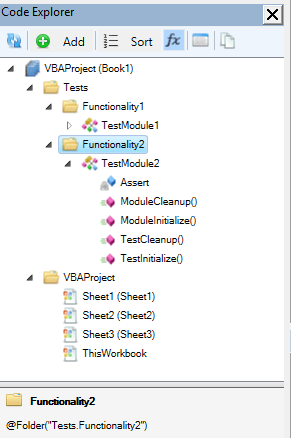
You can control which module appears under which folder by modifying the annotation, using the dot (“.”) as a separator:

folders2.PNG

The Code Explorer‘s bottom panel shows the @Folder annotation that’s responsible for creating the selected folder, when a folder is selected (if no folder is specified, everything goes to a default “VBAProject” folder).

In this case:

'@Folder("Tests.Functionality2")

Or whatever you want to make it. When two or more modules have “Tests” as a “root folder”, Rubberduck knows to show these two modules under the same “Tests” folder.

This means large VBA projects with a ton of classes can now be organized in folders for easier browsing, like large VB.NET projects are organized in namespaces. Now VBA doesn’t support namespaces, the rules haven’t changed: you can’t have two same-name modules in the same VBA project regardless of which “folder” you’re putting them in. But it sure makes it much easier to organize things.

The reason we can’t have a simple “create folder” command, is ultimately because VBA doesn’t support folders: we can’t create an empty folder, a folder only exists because there’s a module that has an annotation that created it.

What if there’s more than one annotation?

Rubberduck will only ever use the first @Folder annotation it finds in a module; any subsequent @Folder annotation is ignored. So you can have this:

'@Folder("Tests")
'@Folder("Foo.Bar")

And Rubberduck won’t be confused; the Code Explorer will have that module under the “Tests” folder, and unless there’s another module somewhere that specifies “Foo.Bar”, there won’t be a “Foo.Bar” folder anywhere.

But because multiple @Folder annotations are potentially confusing for us mere mortals, we’ve implemented an inspection that warns you when a module has more than one single @Folder annotation specified:

multiple-folders.PNG

Future versions will probably introduce a quick-fix for that inspection, so that extraneous annotations can be removed without even looking at the code module itself.


@IgnoreModule

Sometimes a single module can be responsible for a lot of inspection results, and that module can’t really be changed/fixed right now because, y’know, reasons – so you’d like to prevent Rubberduck inspections from looking at that module, so you can focus on inspection results from other modules without drowning them in noise from a module you’d like to ignore.

Since 2.0.12 you can now make code inspections completely ignore a specific module, with a single module-level annotation:

'@IgnoreModule

Now that’s great, but it’s also drastic: all inspections will ignore that module. If all you wanted was to shut off the use meaningful names inspection for that module without disabling the inspection itself, you can parameterize the annotation:

'@IgnoreModule UseMeaningfulName

And now only the use meaningful name inspection will be ignored in that module, without turning off the inspection itself.

So how do you know what inspection names to use? These names are the actual internal class names (minus the “Inspection” suffix) of each inspection in the Rubberduck code base itself, so they’re not exactly easy to get if you’re not looking at the Inspections namespace… fortunately the project’s website uses the Rubberduck build itself to create the Inspections/List page, and the inspection names appear in the bullet-list:

all-inspections.PNG

…of course, the website processes the names to insert spaces (based on the PascalCase casing – that’s why ByVal appears as “By Val”), so the actual usable @Ignore and @IgnoreModule annotation parameters are all in that list, except you need to remove the spaces when using them.

The @Ignore annotation uses the same mechanism, except it works at individual inspection result level; the Ignore Once quickfix that’s available for most inspections, automatically inserts @Ignore annotations, but there’s currently no way to automatically add an @IgnoreModule annotation – future versions will most definitely fix that though.

Up for Grabs

One of the best things about open-source software is that, when you find a bug as a user, you can not only report it to the developers, but also dig into the source code yourself and perhaps locate and fix the problem and PR it into the next release.

From the very beginning of our GitHub history, we’ve used issues as our “to-do” list, the “project backlog”. With GitHub projects we have subdivided the issue list into easier-to-track projects, as was shown last month. Thing is, with the few of us, the lots of you and the pretty wide project scope, the “to-do” list is constantly growing with awesome ideas.

There’s quite a lot to do in Rubberduck, and because we’d like you to help us do this, a lot of these things have an [up-for-grabslabel in our repository.

Some are easier than others. Of course it’s not always obvious to assess the “difficulty level” of an issue, but we can try:

difficulty-levels

Duckling (14 open) is labeling the “simple” issues we think don’t really require much experience with the code base. e.g. #1732 Inspection for empty modules

Ducky (17 open)  issues are more involved than duckling; if you haven’t been poking around too much, these ones might be more challenging. e.g. #2704 Concrete implementations should be private

Duck (13 open) issues are for contributors that would like something trickier and/or more substantative to tackle. e.g. #298 VB6 IDE Support

Quackhead (1 open) issues need contributors that know how Rubberduck understands VBA code and interacts with the VBE. e.g. #403 Static Analysis & Code Metrics

And then there’s all the others that we haven’t got around to stick an [up-for-grabs] label on, that you can just go and ask about anytime you like.


But… I don’t do C#!

Doesn’t matter! Our wiki needs to document all the refactorings and inspections; unit testing section could use articles about writing testable, object-oriented VBA code…

@Vogel612 made a translation helper (in Java!), to make it easier to localize Rubberduck and translate the resource files; if you can translate English into a language that’s not yet supported (we had to drop a few languages in 2.0, due to the sheer amount of new but untranslated resource strings), we’ll be happy to guide you and answer every question you might have about any of these resource strings.

But… I don’t do VBA!

Doesn’t matter! In fact, while VBA code is ultimately our data, there’s plenty of areas that don’t even need to get anywhere near actual VBA code. The regex builder tool for example, couldn’t care less about VBA (well aside from building VBScript-flavored regex…), and traversing an expression tree to evaluate/interpret it, determining if a conditional evaluates to a constant, …these things aren’t VBA-specific – they’re just things you need to work with, regardless of what language your data is written with. Except BrainFuck perhaps. Point is, knowing VBA helps, but the core team is there to help too if need be…

I mean, how much VBA do you need to know in order to be able determine whether a module is empty?


So, 2.0.12 is late… what’s cooking?

Recently I tweeted this:

The release of Rubberduck 2.0.12, due 5 days ago, is being delayed because we have something awesome cooking up. Give us 2-3 more weeks 🙂

TL;DR: if awesomeness can be cooked, that’s what’s cooking.

The amount of work that went into the upcoming release is tremendous. We’ve been trying to figure out exactly what was blowing up when the VBE dismantled itself and the host was shutting down, causing that pesky crash on exit… ever since we’ve introduced WPF user controls in dockable toolwindows. And at last, solved it.

We’ve been working on improving performance and thread safety of the entire parsing engine, and fixed a few grammar/parser bugs on the way, including a long-standing bug that made redundant parentheses trip a parse exception, another with the slightly weird and surely redundant Case Is = syntax, and @Magic annotations can now legally be followed by any comment, which is useful when you want to, well, annotate an annotation:

'@Ignore ProcedureNotUsed; called by [DoSomething] button on Sheet12
Public Sub DoSomething()
    ...
End Sub

We’ve enhanced the COM reference collector such that the resolver has every bit of useful information about everything there is to know in a type library referenced by a VBA project. This allows us to enhance other features, like the context-sensitive commandbar that tells you what Rubberduck is your selection as, e.g. a TextBox control in a UserForm:

textbox

(don’t mind that “Serialize” button – it’s only there in debug builds ;^)

Oh, and then there’s the interactions with the website – we’ll be running the inspections and the indenter on the website, and we’ll have the ability to (optionally) have Rubberduck know when a new version is available!


2.0.12 is going to be epic.

The 2.0 build

And then there’s even more: we’re going to make the inspections a concern of the parser engine, and turn them into parse tree node annotations – which means the code that currently finds the Declaration that’s currently selected (or one of its references), can also be used to find inspection results associated with that particular Declaration; this will probably prompt a redesign of how we present inspection results, and will definitely improve performance and memory footprint.

One of the best 2.x features is probably going to be the add/remove references dialog, which is currently merely prototyped. Beefing up unit testing with data-driven tests is also going to be a big one.

And when you see where we want to be for 3.0 (code path analysis & expression resolution, plug-in architecture, a subclassed CodePanethat actually tells us what’s going on, perhaps even with our own enhanced IntelliSense, more host-specific behaviors, TONS of new inspections), …this project is so awesome, I could just keep going on and on.

Not coming soon enough? I know, right!

cr-ducky-great-again-600x500.

To be continued…


Issues, Milestones and Projects

When the Rubberduck project was first put on GitHub, we quickly decided to use issues as our “todo list”. Right then, we knew we were going to need some label system. Since everything had started on a Stack Exchange site, labels were made to look like SE tags – and came to be used as such: our “categories” labels are all the same color: DDDDDD.

tags

“Oh wow, that must be so boring!”, right?

A little bit, indeed. So we made the status tags red (B60205), the meta-tags almost-white (FEFEFE), subcategories dark gray (808080); then we have [support] in blue (0077AA), [up-for-grabs] in forest green (0E8A16) and [help-wanted] in bright gold (FBCA04), to catch the eye easily.

So we went on a spree and created an issue for every feature we (then) could think of, and Rubberduck was officially kicked off as a long-term project, and I felt like we were managing it ok.

Especially since we started creating milestones and assigning one to issues. One mistake you don’t want to make, is to create a Next Release milestone – before you know it it’s impossible to know what was fixed when!

So a milestone was created for the “initial release”, then for “version 1.1”. Then I created one dedicated to get parsing powered by ANTLR – milestones were no longer release dates, but now little projects within the project, being worked on as reported and discovered bugs were assigned under the release milestone.

It worked that way until.. very recently. Looking back, I’d say what didn’t work was that our releases were revisions but our milestones were minor releases – so there was an undetermined number of releases under one given milestone. “v2.0.12” is the first milestone in the repository that’s actually numbered after a revision – and against which there will be only one release.

So, to recap:

  • Issues ideally describe one bug or feature request
  • Milestones ideally regroup all issues to be closed for a given release

Starting with 2.0.11/12, we’re going to be shooting for monthly releases, so a new milestone should be created every month or so: Rubberduck releases have been pretty random up to this point, and with a release-per-milestone it’s going to be much easier to plan and track the “current sprint”.

Or will it? Something is missing.

Projects

That’s what the “little projects within the project” milestones should have been from the beginning: a project. On GitHub a project lets you create columns to move cards to/from, and if you add an issue as a card to your “In Progress” column, the issue page will say “In Progress in [Project]” in the side bar.. which is pretty cool!

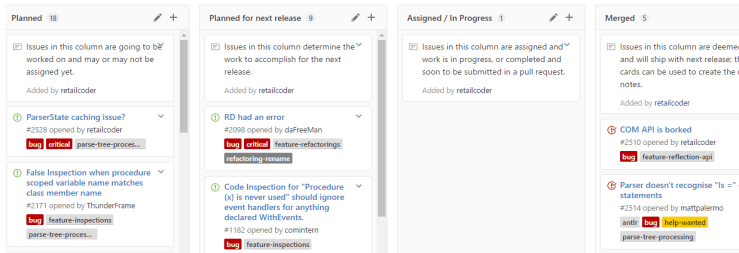
board.PNG

As of yesterday, Rubberduck has two types of projects:

Things we plan and track for [every] next release

There’s two of them:

  • Features tracks feature requests and enhancements to existing features.
  • BugSlayer tracks all reported bugs.

These projects have columns that help plan work, and visualize everything much more easily than with the issues list:

  • Requested / Reported
  • Deferred / Hold
  • Planned
  • Planned for next release
  • Assigned / In Progress
  • Merged
  • Released

Things we plan and track for some eventual release

When an important feature requires more work than can reasonably be tracked with a single issue / card in the Features project, a project board dedicated to that feature can be created to make it easier to track work and facilitate collaboration.

These projects have a “classical” set of columns:

  • TODO
  • In Progress
  • Done

Do you need all that for a small side-project? Maybe not… but I don’t see how it can hurt. Rubberduck isn’t really a small project anymore, though, but it’s still built by a handful of people that find a few spare hours to devote regularly. With the number of open issues (over 300), tracking things in the issues list was starting to feel like tracking help desk tickets with Outlook email follow-up flags – GitHub projects change everything. Heck, I think they’re making me start liking project management!