What’s Next?

The v3 full rewrite failed, obviously. The project was simply too ambitious for the limited capacity of an open-source weekend project.

Rubberduck is at a crossroads: either there’s a way forward, or sooner or later it’s a way to the graveyard.

You thought this was going to be about Rubberduck going “on indefinite pause”, didn’t you? If you haven’t seen the recent movement around the project’s website and GitHub organization, I wouldn’t blame you for thinking so, but…

I can’t let that happen to Rubberduck. This project means too much to me, to just let it die like this.

Not after all the blood, guts, and sweat that went into it.

It’s 2026. VBA has been “dead” for what, 20 years now? It’ll be “dead” for another 15 and Microsoft will still do nothing about modernizing VBA: they’ve essentially left that ground to the community – and that’s us.

And I’m perfectly fine with that.

I have no idea how big or small Rubberduck’s user base is; all I have is rough estimates. I know the total number of installer downloads for any given release tag, that’s all. I never collected any data from our users, because an OSS project that can’t sign their code shouldn’t be doing that, plus where’s the infra and who’s paying for it? I’ve poured quite a lot of my own money into this over the course of the past decade or so, and Enterprise-approvable, certified/signed code is crazy expensive and simply wasn’t going to happen under a pure open-source GPLv3 model at my sole expense.

Meanwhile we’ve built a reputation for ourselves and are now positioned as the reference for professional-level VBA code, and Microsoft’s own flagship AI tool – Copilot – spontaneously names Rubberduck as the best tool in the ecosystem in 2026 and validates our unit testing features as a unit testing framework that is comparable to industry-standard NUnit/JUnit. To me it says something about how deep the actual reach goes, and how dead VBA actually still isn’t.
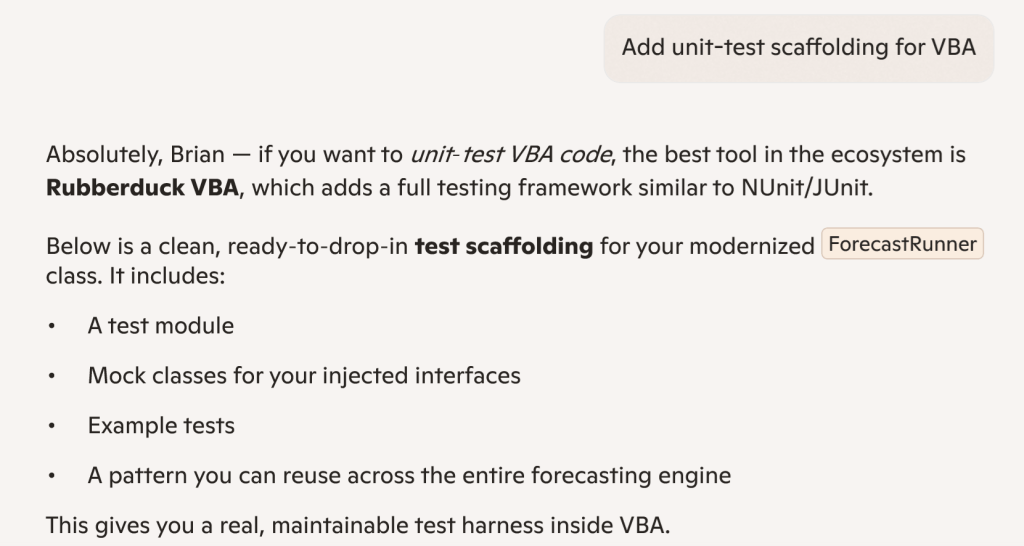
“the best tool in the ecosystem is Rubberduck VBA”, says none other than Microsoft’s very own Copilot. Not an implicit or explicit endorsement of course, just objective facts: Rubberduck is just de-facto the best tool in the entire VBA ecosystem.
The mission is accomplished.

Are we done beating around the bush now?

Yes: I’m going all in.

Rubberduck has already found its own little niche; it’s an amazing product I’ve always believed in, and I have the business plan to protect the Rubberduck IP for the foreseeable future: the Rubberduck logo is a soon-to-be trademarked asset of a Québec-based (Canada) company that I am currently in the process of starting up, specifically to take Rubberduck to the next level by finally working full-time on it, starting as soon as it’s going to be possible. Now before anything else let me be very clear:

Rubberduck will always be free and open-source, including its future iterations.

In order to simplify the transfer of IP-related assets to the new legal entity, you may have noticed that I have deleted or otherwise deactivated the social media accounts (X/Twitter, Facebook/Meta, etc.), along with the Ko-fi and PayPal accounts. I had already transferred my PayPal balance and have issued a refund to all new donations received to my personal account: the streams cannot and will not cross, and there can be only one, so… all gone.

This blog will be archived. Being a Québec-Inc. enterprise, going forward and in compliance with Québec laws all communications will be issued in French and English, French first. DNS registration for rubberduckvba.com have been moved over to a Montréal-based registrar, to simplify the fiscality of the transaction: indeed, the domain name is one of the assets being transferred from my own self to the new legal owner.

Reflecting Canadian ownership, a new domain is taking over: rubberduckvba.ca will now be served instead of the historical .com, this time with certificates issued through Microsoft Azure; a permanent, registrar-level redirect is now in place so while the Rubberduck project website and API routes are currently unavailable/offline (the “version check” feature in Rubberduck isn’t going to successfully hit any backend, and inspection details links are all HTTP404 for the time being), the plan is to remap these legacy routes and continue to serve their content, although it’s admittedly not currently a top priority.

The GitHub repositories have been archived. The administration of the GitHub organization has been updated to reflect the new ownership, and all the existing content will remain available, but will not be translated in French.

It’s the end of this blog then?

Depends how you see it, really. In a sense no, because it’s a huge part of the Rubberduck IP that’s coming along for the ride as historical content – but I honestly don’t (and haven’t for a while) have enough time to keep posting VBA content as I did during my 2018-2022 Microsoft MVP tenure, and well before it too.

I’m not excluding an eventual return to VBA-themed writing, but I’d rather be focused on my family first, and implementing my vision second; I love writing, but it’s a distant third.

So… What’s next?

I can’t yet disclose what’s next, actually. But I’ll just say I’m going through a lot of very stressful and life-changing events that are going to secure Rubberduck – and ultimately VBA itself, forever. Mark my words:

This company will make VBA immortal.

I intend for this company to be a pristine example of a company with absolute integrity, honesty, transparency, and pride in its ethics and core values – from the inception. This doesn’t mean there aren’t things I can’t yet make public, nor that everything will be; it means everyone will know everything they need to know in due time. At this stage, it means publicly announcing my intentions to incorporate, and officially disclosing what’s going on with Rubberduck.

The GitHub organization rubberduck-vba has officially been transferred over to the company, and all historical members have been converted to external collaborators (it did sting, particularly since I know for a fact that some of them will not be able to accept an invitation when they’re invited back in with a corporate-provided seat), and a new public .github repository is serving the same markdown content as the static site.

Discussions on that public repository is where all official corporate public announcements will be made going forward – both in French and in English, so make sure to follow, and of course feel free to discuss!

To be continued… just not here.

Coming soon, in Rubberduck 2.2

The last “green” release was a couple of months ago already – time to take a step back, look at all we’ve done, and call it a “minor” update.

What’s up duck?

Functionality-wise, not much. Bug fixes, yes; this means fewer inspection false positives, fewer caching accidents, overall more stable usage. But this time some serious progress was also made in the COM & RCW management area, and Rubberduck 2.2 no longer crashes on exit, or leave a dangling host process, or brick the VBE on reload. Some components are still stubbornly refusing to properly release, so unload+reload is still a not-recommended thing to do, but doing so no longer causes access violations. Which is neat, because this particular problem had been plaguing Rubberduck since the early days of 2.0.

Source Control Disintegration

If you haven’t been following the project since v2.1 was released, you may be disappointed to learn that we are officially dropping the source control integration feature. Not saying it’ll never resurface, but the feature was never really stable, and rather than drain our limited resources on a nice but non-essential feature, we focused on the “core” stuff for now. So instead of keeping the half-baked, half-broken thing in place, we removed it – entirely, so there’s 0 chance any part of it interferes with anything else (there were hooks in place, handling parser state changes and some VBE events).

The “Export Project” functionality remains though, so you can still use your favorite source control provider (Git, SVN, Mercurial, etc.) – Rubberduck just isn’t providing a UI to wrap that provider’s functionality anymore.

Shiny & New

We have new inspections! Rubberduck can now tell you when a Case block is semantically unreachable. Or when For loops specify a redundant Step 1, or if you prefer having an explicit Step clause everywhere, it can tell you about that too. Another inspection warns about error-handling suppression (On Error Resume Next) that is never restored (On Error GoTo 0). If you’re unfortunate enough to encounter the thoroughly evil Def[Type] statements, you’ll be relieved to know that Rubberduck will now warn you about implicitly typed identifiers.

Code Metrics is an entirely new tool, that evaluates cyclomatic complexity and nesting levels of each method and module. The feature clearly needs some UI work (wink wink, nudge nudge, C#/WPF reader), and enhancement ideas are always welcome.

The unit test execution engine no longer invokes the host application. There’s a bit of black magic going on here, but to keep it simple, the unit testing feature now works in every single VBE host application.

But the most spectacular changes aren’t really tangible, user-facing things. We’ve streamlined settings, upgrated our grammars from Antlr4.3 to Antlr4.6 – which fixed a number of parser issues, including significant performance improvements when parsing long Boolean expressions; the IInspection interface was fine-tuned again, COM object references were removed in a number of critical places. If you have a fork of the project, you already know that we’ve split Rubberduck.dll into Rubberduck.Core.dll and Rubberduck.Main.dll, with the entry point and IoC configuration in ‘Main’.

Oh, I lied. One of the most spectacular changes is a tangible, user-facing thing. It’s just not exactly in the main code base, is all. Poor installer, always gets left behind.

Administrative Privileges no longer needed!

Since a couple of pre-release builds, the Rubberduck installer supports per-user installs that no longer require admin privs. This means Rubberduck can now be installed on a locked-down workstation, without requiring IT intervention! This revamped installer also detects and properly uninstalls a previous Rubberduck install (admin elevation would be required to uninstall a per-machine installation of a previous build though), so manually uninstalling through the control panel before upgrading, is no longer recommended/needed. Doesn’t hurt, but shouldn’t change anything, really.

The “installating / instructions” and “contributing / initial setup” wiki pages have been updated accordingly on GitHub.

This new installer no longer assumes Microsoft Office is present, and registers for both 32 and 64-bit host applications.


That’s it? What happened to the rest of 2.1.x?

I did say “minor update”, yeah? The previously announced roadmap for 2.1.x was too ambitious, and not much of it is shipping in this release. In fact, that roadmap should have said “2.x”… versioning is hard, okay? If we stuck to 2.1.x, then a v2.2 would have been moot, since by then we would have had much of 3.0 in place.

Anyway, 2.2 is a terrific improvement over 2.1, on many levels – and that can only mean one thing: that the current development cycle will inevitably lead to even more awesomeness!

RD2018

Up for Grabs

One of the best things about open-source software is that, when you find a bug as a user, you can not only report it to the developers, but also dig into the source code yourself and perhaps locate and fix the problem and PR it into the next release.

From the very beginning of our GitHub history, we’ve used issues as our “to-do” list, the “project backlog”. With GitHub projects we have subdivided the issue list into easier-to-track projects, as was shown last month. Thing is, with the few of us, the lots of you and the pretty wide project scope, the “to-do” list is constantly growing with awesome ideas.

There’s quite a lot to do in Rubberduck, and because we’d like you to help us do this, a lot of these things have an [up-for-grabslabel in our repository.

Some are easier than others. Of course it’s not always obvious to assess the “difficulty level” of an issue, but we can try:

difficulty-levels

Duckling (14 open) is labeling the “simple” issues we think don’t really require much experience with the code base. e.g. #1732 Inspection for empty modules

Ducky (17 open)  issues are more involved than duckling; if you haven’t been poking around too much, these ones might be more challenging. e.g. #2704 Concrete implementations should be private

Duck (13 open) issues are for contributors that would like something trickier and/or more substantative to tackle. e.g. #298 VB6 IDE Support

Quackhead (1 open) issues need contributors that know how Rubberduck understands VBA code and interacts with the VBE. e.g. #403 Static Analysis & Code Metrics

And then there’s all the others that we haven’t got around to stick an [up-for-grabs] label on, that you can just go and ask about anytime you like.


But… I don’t do C#!

Doesn’t matter! Our wiki needs to document all the refactorings and inspections; unit testing section could use articles about writing testable, object-oriented VBA code…

@Vogel612 made a translation helper (in Java!), to make it easier to localize Rubberduck and translate the resource files; if you can translate English into a language that’s not yet supported (we had to drop a few languages in 2.0, due to the sheer amount of new but untranslated resource strings), we’ll be happy to guide you and answer every question you might have about any of these resource strings.

But… I don’t do VBA!

Doesn’t matter! In fact, while VBA code is ultimately our data, there’s plenty of areas that don’t even need to get anywhere near actual VBA code. The regex builder tool for example, couldn’t care less about VBA (well aside from building VBScript-flavored regex…), and traversing an expression tree to evaluate/interpret it, determining if a conditional evaluates to a constant, …these things aren’t VBA-specific – they’re just things you need to work with, regardless of what language your data is written with. Except BrainFuck perhaps. Point is, knowing VBA helps, but the core team is there to help too if need be…

I mean, how much VBA do you need to know in order to be able determine whether a module is empty?


So, 2.0.12 is late… what’s cooking?

Recently I tweeted this:

The release of Rubberduck 2.0.12, due 5 days ago, is being delayed because we have something awesome cooking up. Give us 2-3 more weeks 🙂

TL;DR: if awesomeness can be cooked, that’s what’s cooking.

The amount of work that went into the upcoming release is tremendous. We’ve been trying to figure out exactly what was blowing up when the VBE dismantled itself and the host was shutting down, causing that pesky crash on exit… ever since we’ve introduced WPF user controls in dockable toolwindows. And at last, solved it.

We’ve been working on improving performance and thread safety of the entire parsing engine, and fixed a few grammar/parser bugs on the way, including a long-standing bug that made redundant parentheses trip a parse exception, another with the slightly weird and surely redundant Case Is = syntax, and @Magic annotations can now legally be followed by any comment, which is useful when you want to, well, annotate an annotation:

'@Ignore ProcedureNotUsed; called by [DoSomething] button on Sheet12
Public Sub DoSomething()
    ...
End Sub

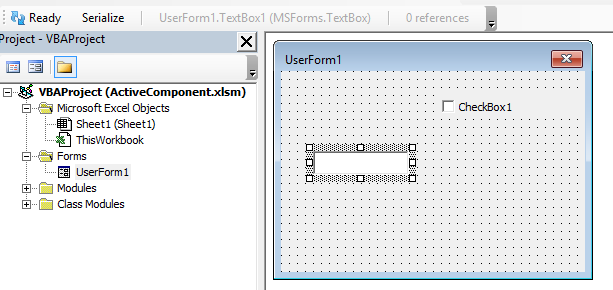
We’ve enhanced the COM reference collector such that the resolver has every bit of useful information about everything there is to know in a type library referenced by a VBA project. This allows us to enhance other features, like the context-sensitive commandbar that tells you what Rubberduck is your selection as, e.g. a TextBox control in a UserForm:

textbox

(don’t mind that “Serialize” button – it’s only there in debug builds ;^)

Oh, and then there’s the interactions with the website – we’ll be running the inspections and the indenter on the website, and we’ll have the ability to (optionally) have Rubberduck know when a new version is available!


2.0.12 is going to be epic.

The 2.0 build

And then there’s even more: we’re going to make the inspections a concern of the parser engine, and turn them into parse tree node annotations – which means the code that currently finds the Declaration that’s currently selected (or one of its references), can also be used to find inspection results associated with that particular Declaration; this will probably prompt a redesign of how we present inspection results, and will definitely improve performance and memory footprint.

One of the best 2.x features is probably going to be the add/remove references dialog, which is currently merely prototyped. Beefing up unit testing with data-driven tests is also going to be a big one.

And when you see where we want to be for 3.0 (code path analysis & expression resolution, plug-in architecture, a subclassed CodePanethat actually tells us what’s going on, perhaps even with our own enhanced IntelliSense, more host-specific behaviors, TONS of new inspections), …this project is so awesome, I could just keep going on and on.

Not coming soon enough? I know, right!

cr-ducky-great-again-600x500.

To be continued…


Issues, Milestones and Projects

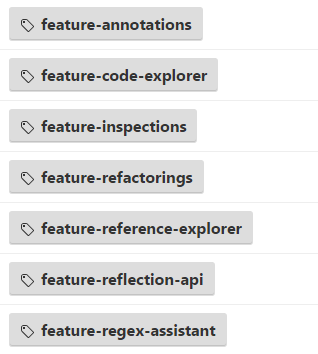
When the Rubberduck project was first put on GitHub, we quickly decided to use issues as our “todo list”. Right then, we knew we were going to need some label system. Since everything had started on a Stack Exchange site, labels were made to look like SE tags – and came to be used as such: our “categories” labels are all the same color: DDDDDD.

tags

“Oh wow, that must be so boring!”, right?

A little bit, indeed. So we made the status tags red (B60205), the meta-tags almost-white (FEFEFE), subcategories dark gray (808080); then we have [support] in blue (0077AA), [up-for-grabs] in forest green (0E8A16) and [help-wanted] in bright gold (FBCA04), to catch the eye easily.

So we went on a spree and created an issue for every feature we (then) could think of, and Rubberduck was officially kicked off as a long-term project, and I felt like we were managing it ok.

Especially since we started creating milestones and assigning one to issues. One mistake you don’t want to make, is to create a Next Release milestone – before you know it it’s impossible to know what was fixed when!

So a milestone was created for the “initial release”, then for “version 1.1”. Then I created one dedicated to get parsing powered by ANTLR – milestones were no longer release dates, but now little projects within the project, being worked on as reported and discovered bugs were assigned under the release milestone.

It worked that way until.. very recently. Looking back, I’d say what didn’t work was that our releases were revisions but our milestones were minor releases – so there was an undetermined number of releases under one given milestone. “v2.0.12” is the first milestone in the repository that’s actually numbered after a revision – and against which there will be only one release.

So, to recap:

  • Issues ideally describe one bug or feature request
  • Milestones ideally regroup all issues to be closed for a given release

Starting with 2.0.11/12, we’re going to be shooting for monthly releases, so a new milestone should be created every month or so: Rubberduck releases have been pretty random up to this point, and with a release-per-milestone it’s going to be much easier to plan and track the “current sprint”.

Or will it? Something is missing.

Projects

That’s what the “little projects within the project” milestones should have been from the beginning: a project. On GitHub a project lets you create columns to move cards to/from, and if you add an issue as a card to your “In Progress” column, the issue page will say “In Progress in [Project]” in the side bar.. which is pretty cool!

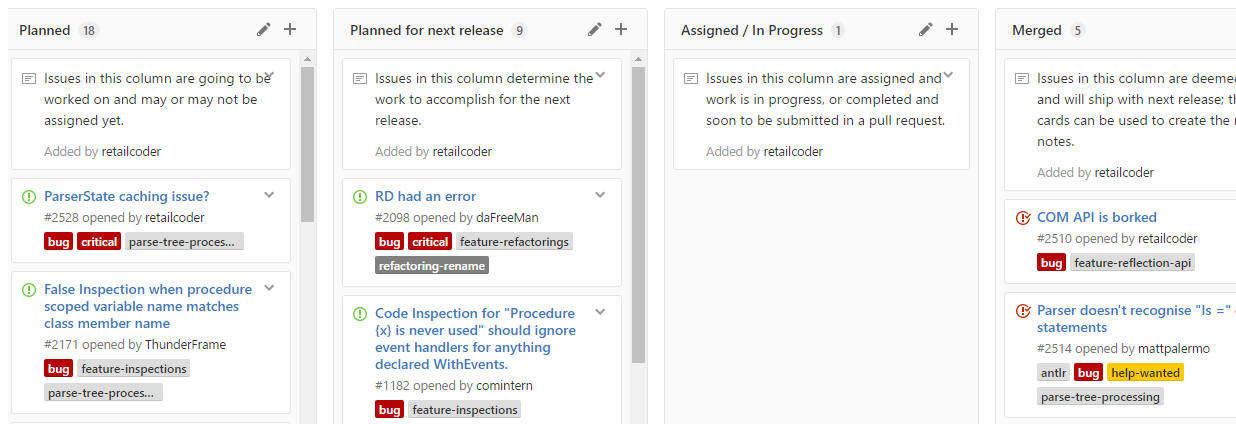
board.PNG

As of yesterday, Rubberduck has two types of projects:

Things we plan and track for [every] next release

There’s two of them:

  • Features tracks feature requests and enhancements to existing features.
  • BugSlayer tracks all reported bugs.

These projects have columns that help plan work, and visualize everything much more easily than with the issues list:

  • Requested / Reported
  • Deferred / Hold
  • Planned
  • Planned for next release
  • Assigned / In Progress
  • Merged
  • Released

Things we plan and track for some eventual release

When an important feature requires more work than can reasonably be tracked with a single issue / card in the Features project, a project board dedicated to that feature can be created to make it easier to track work and facilitate collaboration.

These projects have a “classical” set of columns:

  • TODO
  • In Progress
  • Done

Do you need all that for a small side-project? Maybe not… but I don’t see how it can hurt. Rubberduck isn’t really a small project anymore, though, but it’s still built by a handful of people that find a few spare hours to devote regularly. With the number of open issues (over 300), tracking things in the issues list was starting to feel like tracking help desk tickets with Outlook email follow-up flags – GitHub projects change everything. Heck, I think they’re making me start liking project management!