Website Update: It’s Live!

The rubberduckvba.com website has been in a sad state for a very long time, and I have been working on a new version written with .net8 and the latest Angular framework so it could finally keep up and benefit from the latest additions to C# and the .net framework… all while moving hosting out of GoDaddy, because it makes no sense to be paying this much for SSL in 2024.

I went with what I know, so it’s a WinServer machine that runs IIS and a SQL Express instance. I learned a lot of things in the process and I’m happy everything is mostly working now: both test.rubberduckvba.com and rubberduckvba.com are now being served from an Azure VM that I fully control, with SSL certificates automatically renewing monthly for free with Let’s Encrypt.

The most important part was the backend part that reads xmldoc from Rubberduck release assets it downloads from GitHub and then synchronizes all the inspections and quickfixes and annotations in the database (marking as new ones that exist in next but not in main, or as discontinued those that exist in main but not in next). That and the (related) pipeline that gets the latest tags from GitHub, and updates the download stats on the home page:

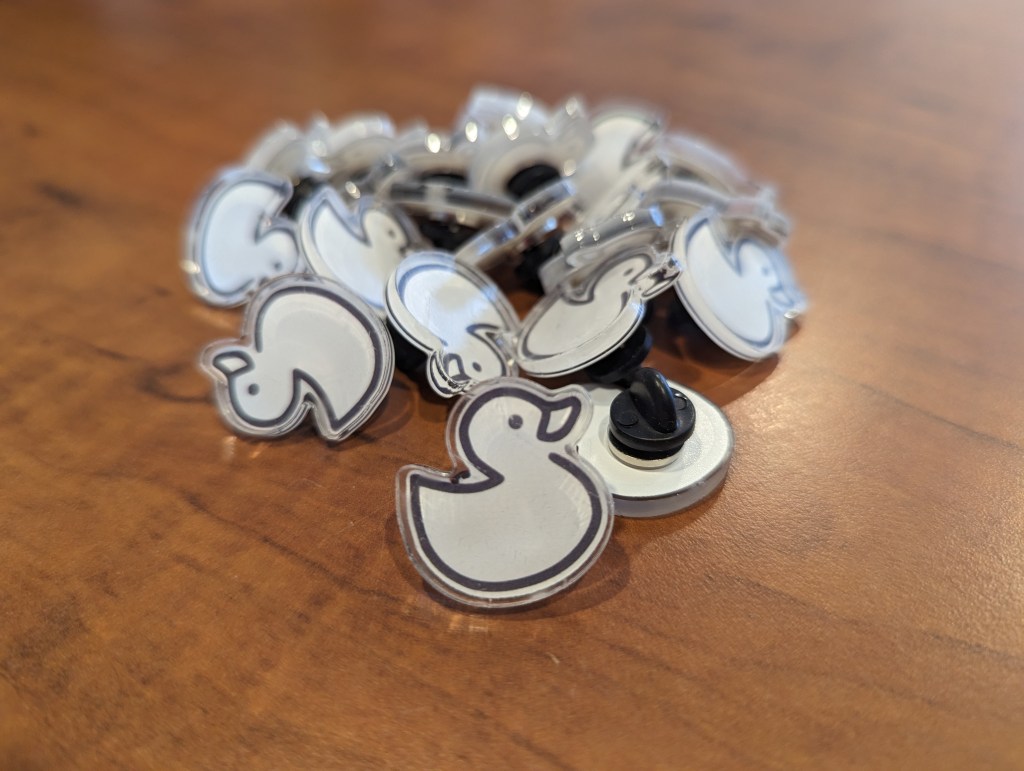
A fresh new look for the site’s landing page, with a sleek revisited “outline” ducky icon – this time an actual SVG, so no more fuzzy blur!

Some work is still needed to correctly parse before/after examples for the annotations, and some legacy routes (e.g. /FeatureDetails?name="SomeQuickFix") are probably broken now, but pretty much everything that should be working, is working. The new site is much more snappy and responsive, and will be much easier to maintain as well: the source code is on GitHub at last, and should work locally with minimal setup for Angular/AngularCLI and perhaps a handful of environment variables.


Gone: redirect from rubberduck-vba.com

When I first signed up with GoDaddy in 2015, the domain I registered had the dash in it, mirroring the name of the GitHub organization. I think it’s when the ASP.NET/WebForms site went up that I registered the domain without the dash; the old domain would have pointed to the WebsiteBuilder thing, and when the new one went live I made the old dash domain a permanent http-redirect… and kept the old domain since then.

It’s been almost a decade, it’s time to let it go, for the same reason there’s not also a .org or .info or whatever – take it, be my guest. The no-dash domain however, remains under my wing for the foreseeable future.


Next steps

I needed to go live very soon to beat the GoDaddy renewals, so all the markdown content is exactly the same as it was on the old site, but some of it is kind of outdated and some features are missing, so expect this content to move a bit in the next couple of days.

With the old site, I’d login with GitHub and then as an authenticated administrator on the site I had tools to edit this markdown content; the backend part for the login has been implemented in the new site as well, but the client-side functionality isn’t there yet; I’d like to take the time to do this, otherwise I might as well just keep it all as static content directly in the HTML, but I like how markdown makes it easy to format a simple document, plus I got VBE-styled, Rubberduck-parsed code blocks to render as intended, so… the admin functionality is pretty high on my list right now.

Breaking changes would be high on that list as well, but as far as I know we’re all good.

In-app links to specific inspection pages should be working now, but the legacy /build/version routing did not make the cut: it dates all the way back to the ASP.NET (WebForms) site where I’d manually upload a copy of the rubberduck.dll to the server, and the site would use its version to advertise that a new one was available, and there was no backend API and multiple pages so it was easy to make a route that just returned a version string that Rubberduck could check against its own version on startup… but wow, what a silly idea. I did see a number of hits in the IIS logs while I was getting the prod site up, so that means some old pre-2.0 builds are still out there doing their thing, that’ll start failing to… tell the user about a newer available version; the newer builds hit the backend API directly instead, which returns a JSON string that can contain more information about the latest release than just a string with a version number – like a tag name and a download URL.

So yeah, some tweaks here and there, a revisiting of the markdown content, adding the Rubberduck.Mocks feature, and then some quick admin tools to maintain that content, and then I can draw another line and call it done and move on to the next thing; any changes will be deployed to the test site first, but at the moment there’s only one backend database, so any content changes made on the test site will affect the production site… which isn’t ideal, and won’t stand for long. Then there are a number of redundant requests and database hits that need to be axed, and caching has yet to be implemented and will further improve performance and significantly reduce the overall resource consumption of the VM which is something I need to keep an eye on, now that I manage it.


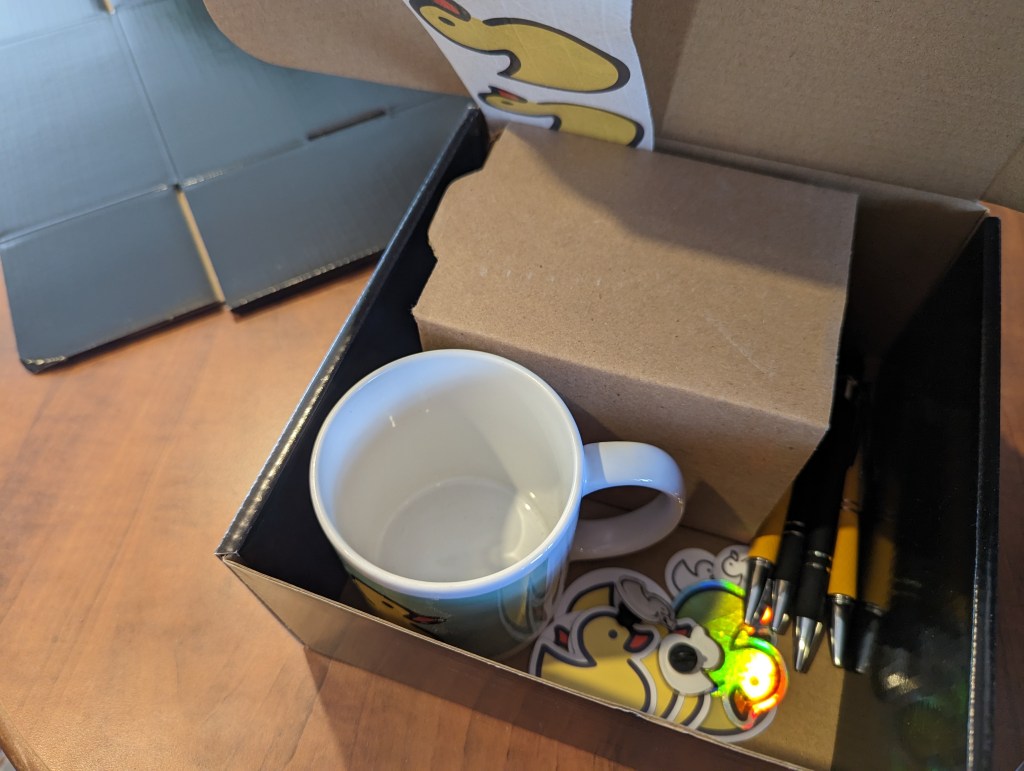
Rubberduck Swag Shop is Open!

Back in the summer of 2017, we ran a rather successful GoFundMe campaign to collect funds to get some swag made, and shipped to the project’s contributors. It was great to see all that support pouring in, but it was bittersweet… for I would have loved to have been able to materially thank back our supporters. Alas, making custom printed gear quickly gets expensive, and crazy shipping fees essentially doubled it up.

So this time around I decided to bite the bullet and make a more significant initial investment, and actually start an online shop and keep an inventory in stock that can be shipped to supporters whenever, without needing to wait for prints, or paying too much for too few items being made, severely limiting profitability and driving prices up.

I guess I’ll know soon enough if I still have my old merchandise planner’s touch! If the inventory turns too fast, I’ll miss opportunities and may have to delay shipments to replenish. But if the markup is too high and stock isn’t moving quickly enough, I’ll probably need to take markdowns.

I’ll be writing an article about the particular workbook I’m using to track all that next – I want a bit of VBA code to simplify tracking sales and invoicing.. but for now I’m just thrilled to start shipping all the goodies!

I’m very happy with how everything turned out. That beautiful yellow ducky mug will probably only ever be printed in small batches, for they are quite expensive and I’m unfortunately not going to be able to have a better price for them unless I make them in very large batches. Everything else (even t-shirts, to a degree) has the potential to eventually get to a very decent price point – the goal is obviously to collect some funds to help finance the costs of hosting and securing the blog and website, but I want this inventory to move and don’t mind taking a lower margin if there’s enough volume to drive enough sales to just keep the shop afloat – time will tell!

Rubberduck Swag Shop on Ko-fi

Website News

As I wrote last July, I’ve started to get more time for myself lately, and that means I get to tackle a number of long-standing projects that have been on the backburner for way too long. One of them is the rewrite of the project’s website, which has been “under construction” ever since it was published as an ASP.NET MVC website, a few years ago already.

If you missed it, I tweeted a sneak-peek link last week:

Tweeted 09/28: “A couple of things need a bit of work still, but this website rewrite is coming along nicely – have a peek here: https://test.rubberduckvba.com

Why a rewrite?

For the longest time, I wouldn’t have considered myself a web developer. I have well over a decade of experience in C# desktop development, but the web stuff essentially scared me to death. The version of the website that’s currently live was pretty much my first time doing anything like it. The site itself wouldn’t write to the database; it was another application that pulled the tag metadata, downloaded the xml-doc assets, parsed the documentation and examples, and wrote them to the database.

One of the biggest issues with the current model, is that the database is made to contain HTML that is needlessly difficult to modify:

Unreachable code is certainly unintended, and is probably either redundant, or a bug.
<div><h5>Quick-Fixes</h5>
<p>The following quick-fixes are available for this inspection:</p>
<ul style="margin-left: 8px; list-style: none;">
<li>
<span class="icon icon-ignoreonce"></span>
<a href="https://rubberduckvba.com/QuickFixes/Details/IgnoreOnce">IgnoreOnce</a>
: Adds an '@Ignore annotation to ignore a specific inspection result. Applicable to all inspections whose results can be annotated in a module.</li> 
<li>
<span class="icon icon-tick"></span>
<a href="https://rubberduckvba.com/QuickFixes/Details/IgnoreInModule">IgnoreInModule</a>
: Adds an '@IgnoreModule annotation to ignore a inspection results for a specific inspection inside a whole module. Applicable to all inspections whose results can be annotated in a module.
</li>
</ul>
</div>

Having this HTML markup, CSS classes, and inline styles as part of the data meant the data was being responsible for its own layout and appearance on the site. With the new JSON objects serialized into this Properties column, I could easily keep everything strongly typed and come up with separate view models for inspections, quick-fixes, and annotations, that each did their own thing and let the website in charge of the layout and appearance of everything.

Separation of Concerns

The solution architecture could be roughly depicted like this – I suppose I meant the arrows to represents “depends on” but note that this doesn’t necessarily mean a direct project reference: the Client/API relationship is through HTTPS, and no project in the solution references the Rubberduck.Database SQL Server database project, but ContentServices connects to a rubberduckdb database that you can deploy locally using that database project:

You could draw a thick red line between Rubberduck.Client and Rubberduck.API (actually that’s Rubberduck.WebApi now), and it would perhaps better illustrate the actual wall between the website and the data: the website project doesn’t need a connection string, only a base URL for the API!

Authentication is assured with GitHub’s API using OAuth2: if you authorize the rubberduck-vba OAuth application to your profile, the HttpContext.User is cast as a ClaimsPrincipal and claims the GitHub login as a name, and a rubberduck-org role claim is added when organization membership is validated; an additional rubberduck-admin role claim is added if the user is also a member of the WebAdmin org team.

The website packages the HttpContext.User into a Json Web Token (JWT), an encrypted string that encapsulates the claims; this token is passed as a bearer token in authenticated API requests. The API accepts an Authorize header with either such a bearer token, or a valid GitHub personal access token (PAT).

The API receives a request, and given an Authorization header, either decrypts the JWT or queries GitHub to validate the provided access token and attach the appropriate role claims, before any controller action is invoked.

Another authentication filter performs a similar task to authorize an incoming webhook payload: the rubberduck-webhook role is set and tag metadata and xml-doc content can get updated automatically whenever a new tag/release gets created.

Performance

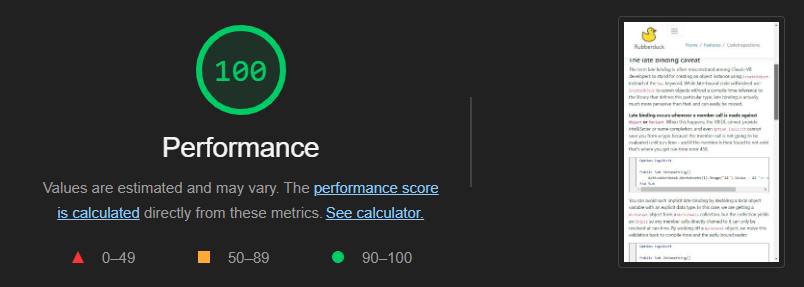
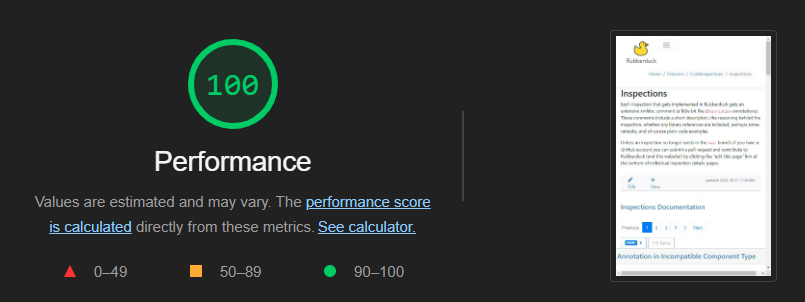
This new website performs much, much better than the current one. It sends asynchronous (ajax) requests to the MVC controller to render partial views, fetching only enough information to paginate the data and present a decent preview. Since most pages are presenting markdown content, an asynchronous request is also sent to format the markdown and, if applicable, apply syntax highlighting to code blocks. At this stage static content isn’t being cached yet, and screenshots should be loaded dynamically – still, performance is quite decent:

Home page scores 94, but then both Code Inspections and Inspections pages (two pages with extensive content, lots of markdown, code blocks, etc.) score a full 100 with Google Lighthouse, so things are looking very good performance-wise.

Another detail: the code examples no longer trigger a page load when you select a tab, so everything just feels much smoother now. Note, as of this writing the example records have been wiped from the database while I work on fixing a problem with the xml-doc processing, so annotations, inspections, and quick-fixes aren’t showing any examples on the test site for now.

Online Indenter

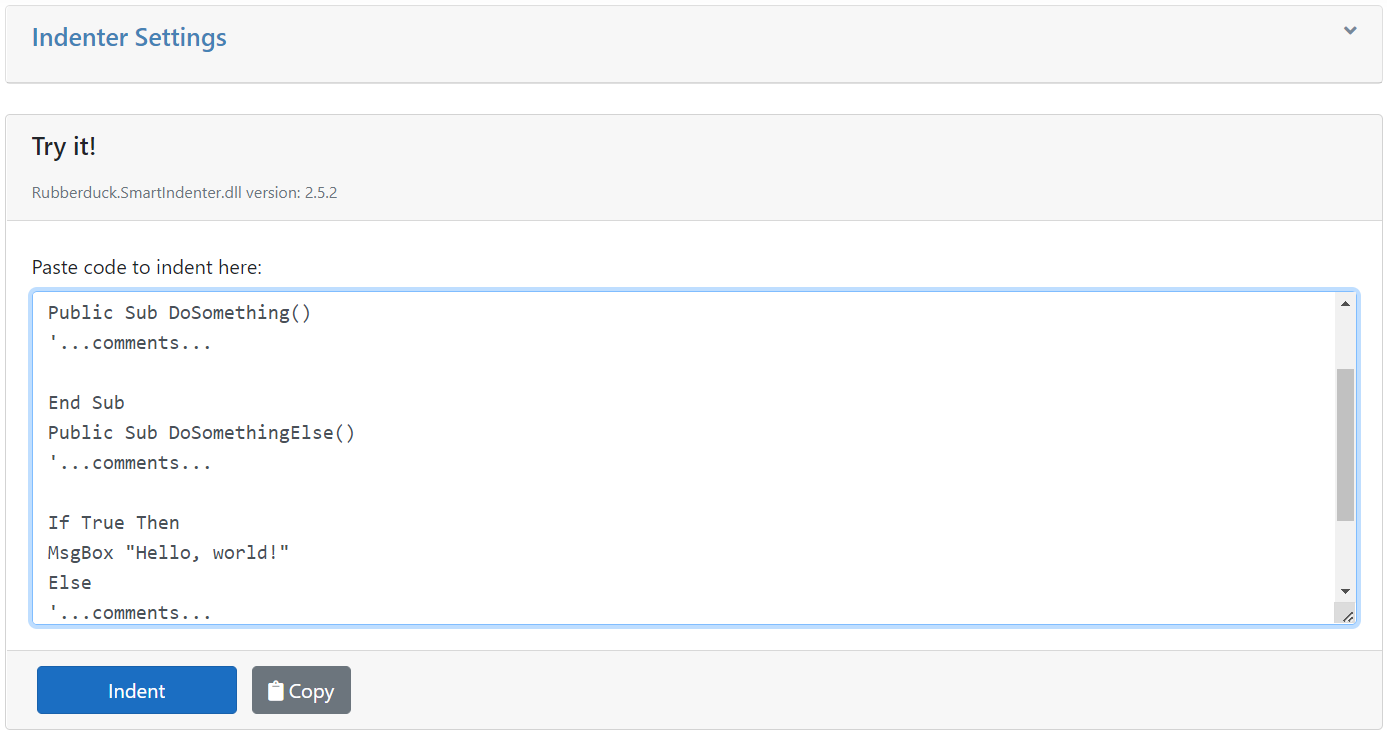
This feature once worked, but then my inexperienced past self, went and broke it in an attempt to make it asynchronous. Well, it’s back online and running Rubberduck.SmartIndenter.dll version 2.5.2:

You can paste VBA code into the box there, click the Indent button, then copy the indented code back into the clipboard.

The code can be indented as per the default indenter settings (which are also used for indenting all syntax-highlighted code blocks on the site), or if you expand the Indenter Settings panel you can tweak every knob Rubberduck’s Smart Indenter port has to offer.

It wouldn’t be too hard to include a “download these settings” button here, to serialize the settings into a .xml file that Rubberduck can then import to update indenter settings.

Content Administration

Users with the appropriate claims will be able to see additional buttons and commands on the site:

A modal dialog allows authenticated users to add and edit markdown content directly on the site.

Content administration features still need a little bit of work, but they are already being used to document how to use each and every single feature in Rubberduck – once this documentation is completed, the site will be a huge user manual, and ready for launch!


What’s Next?

Once everything works as it should (getting very close now!) and all that’s left to do is to take screenshots and generate more content, I’ll shift my focus to the Rubberduck3 project, the ownership of which I’ve now transferred over to the rubberduck-vba organization – the repo remains private for now, but all Rubberduck contributors have access to it. Uploading the RubberduckWebsite solution as a public repository isn’t a priority at this point; I feel like dealing with the implications of having API secrets in a .config file would be a distraction that I don’t need right now. When the time comes, it’ll be properly setup with continuous integration and deployment, but there are other priorities for now.

Like this little guy…

Project planning has begun for Rubberduck 3.0