Posts

OOP Battleship Part 2: The Model

Download the macro-enabled Excel workbook here

Merciless.png
“Merciless” AI (Player1) this close to winning this game

So we’re making a game of Battleship, and we’re going to do this using an object-oriented pattern called Model-View-Controller (MVC). The first thing we need to do, is to modelize the problem in terms of objects. We’re going to need:

  • Player object, so that we know who’s playing on which grid. A player might be human or computer-controlled, and a player has a grid.
  • PlayerGrid object, so that we know the state of each player’s game grid; a player’s grid has a number of ships on it.
  • Ship object that we can place on a player’s grid. A ship has a size and an orientation – we can place them anywhere on the grid, horizontally or vertically; a ship is also going to need to know where it’s hit and whether it’s sunken.
  • GridCoordinate object, to encapsulate X and Y positions and make it easy to pass these two values together as a single entity. This object could have an Offset method that gives us another coordinate at a relative X or Y position.

These objects solve the problem space of modelizing a game of Battleship: with them we have everything we need to track game state. We’ll need something else that can make the players take turns at shooting missiles at each other’s grid, but that will be the controller‘s job; we’ll also need something else that can display the game state and take a human user’s inputs, but that will be the view‘s job. The role of the model is to encapsulate the data that we need to manipulate, and with these objects we’ve got everything we need… for now.

GridCoordinate

Let’s start with the grid coordinates system, since that is our smallest building block, and a grid coordinate doesn’t need to know about a ship or a player interface. We want a grid coordinate to be read-only: once an instance is created for position A1, it’s A1 and remains A1. We want to be able to determine if two grid coordinates are the same without needing to check for both X and Y coordinates every time, and a function that returns True when a coordinate is adjacent to another would be useful, too. Next we’ll want a string representation of the coordinate that lines up with the A1 notation of the game grid, but it would also be useful to have a (x,y) representation that can easily round-trip from a string to a grid coordinate and back, without needing to work out the column number for H.

So the IGridCoord interface would look like this:

'@Folder("Battleship.Model")
'@Description("Describes a coordinate in a 2D grid.")
'@Interface
Option Explicit

'@Description("Gets the horizontal position.")
Public Property Get X() As Long
End Property

'@Description("Gets the vertical position.")
Public Property Get Y() As Long
End Property

'@Description("Creates and returns a new coordinate by offsetting this instance.")
Public Function Offset(Optional ByVal xOffset As Long, Optional ByVal yOffset As Long) As IGridCoord
End Function

'Description("Returns True if the specified coordinate is adjacent to this instance.")
Public Function IsAdjacent(ByVal other As IGridCoord) As Boolean
End Function

'@Description("Returns True if the specified coordinate describes the same location as this instance.")
Public Function Equals(ByVal other As IGridCoord) As Boolean
End Function

'@Description("Returns a (x,y) string representation of this instance.")
Public Function ToString() As String
End Function

'@Description("Returns a A1 string representation of this instance.
Public Function ToA1String() As String
End Function

We’re making it an interface, because otherwise there would be no way of exposing X and Y properties as read-only values. Now we’re going to be writing the game against this IGridCoord interface, rather than against the GridCoord class directly. In order to make it easy to create a grid coordinate by providing an X and an Y value, we’ll give the class a predeclared ID, and use its default instance not to store state, but to expose convenient factory methods.

The listing includes module attributes, so don’t juse copy-paste this in the VBE: you need to import it in a VBA project for it to work.

VERSION 1.0 CLASS
BEGIN
  MultiUse = -1  'True
END
Attribute VB_Name = "GridCoord"
Attribute VB_GlobalNameSpace = False
Attribute VB_Creatable = False
Attribute VB_PredeclaredId = True
Attribute VB_Exposed = True
'@Folder("Battleship.Model")
'@IgnoreModule UseMeaningfulName; X and Y are perfectly fine names here.
Option Explicit
Implements IGridCoord

Private Type TGridCoord
    X As Long
    Y As Long
End Type

Private this As TGridCoord

Public Function Create(ByVal xPosition As Long, ByVal yPosition As Long) As IGridCoord
    With New GridCoord
        .X = xPosition
        .Y = yPosition
        Set Create = .Self
    End With
End Function

Public Function FromString(ByVal coord As String) As IGridCoord
    coord = Replace(Replace(coord, "(", vbNullString), ")", vbNullString)

    Dim coords As Variant
    coords = Split(coord, ",")

    If UBound(coords) - LBound(coords) + 1  2 Then Err.Raise 5, TypeName(Me), "Invalid format string"

    Dim xPosition As Long
    xPosition = coords(LBound(coords))

    Dim yPosition As Long
    yPosition = coords(UBound(coords))

    Set FromString = Create(xPosition, yPosition)
End Function

Public Property Get Self() As IGridCoord
    Set Self = Me
End Property

Public Property Get X() As Long
    X = this.X
End Property

Public Property Let X(ByVal value As Long)
    this.X = value
End Property

Public Property Get Y() As Long
    Y = this.Y
End Property

Public Property Let Y(ByVal value As Long)
    this.Y = value
End Property

Public Property Get Default() As IGridCoord
    Set Default = New GridCoord
End Property

Public Function ToString() As String
    ToString = "(" & this.X & "," & this.Y & ")"
End Function

Private Function IGridCoord_Equals(ByVal other As IGridCoord) As Boolean
    IGridCoord_Equals = other.X = this.X And other.Y = this.Y
End Function

Private Function IGridCoord_IsAdjacent(ByVal other As IGridCoord) As Boolean
    If other.Y = this.Y Then
        IGridCoord_IsAdjacent = other.X = this.X - 1 Or other.X = this.X + 1
    ElseIf other.X = this.X Then
        IGridCoord_IsAdjacent = other.Y = this.Y - 1 Or other.Y = this.Y + 1
    End If
End Function

Private Function IGridCoord_Offset(Optional ByVal xOffset As Long, Optional ByVal yOffset As Long) As IGridCoord
    Set IGridCoord_Offset = Create(this.X + xOffset, this.Y + yOffset)
End Function

Private Function IGridCoord_ToString() As String
    IGridCoord_ToString = Me.ToString
End Function

Private Function IGridCoord_ToA1String() As String
    IGridCoord_ToA1String = Chr$(64 + this.X) & this.Y
End Function

Private Property Get IGridCoord_X() As Long
    IGridCoord_X = this.X
End Property

Private Property Get IGridCoord_Y() As Long
    IGridCoord_Y = this.Y
End Property

So from the default instance, we have access to Create and FromString factory methods, a convenient Default property that gives a (0,0) default coordinate that should be equivalent to the class’ default instance; the writable X and Y properties are meant for instance state: they make no sense outside a factory method.

And now we can create and use a grid coordinate like this:

Dim position As IGridCoord
Set position = GridCoord.Create(3, 4)
Debug.Print position.ToA1String

We can also write a suite of test methods that validate that our GridCoord class behaves as expected in every case… and then make a PlayerGrid class, to represent each player’s grid.

VERSION 1.0 CLASS
BEGIN
  MultiUse = -1  'True
END
Attribute VB_Name = "PlayerGrid"
Attribute VB_GlobalNameSpace = False
Attribute VB_Creatable = False
Attribute VB_PredeclaredId = True
Attribute VB_Exposed = True
'@Folder("Battleship.Model.Player")
Option Explicit

Private Const GridSize As Byte = 10
Private Const MaxShipsPerGrid As Byte = 5

Private Const KnownGridStateErrorMsg As String _
    = "Specified coordinate is not in an unknown state."
Private Const CannotAddShipAtPositionMsg As String _
    = "Cannot add a ship of this size at this position."
Private Const CannotAddMoreShipsMsg As String _
    = "Cannot add more ships to this grid."

Public Enum PlayerGridErrors
    KnownGridStateError = vbObjectError Or 127
    CannotAddShipAtPosition
    CannotAddMoreShips
End Enum

Public Enum AttackResult
    Miss
    Hit
    Sunk
End Enum

Public Enum GridState
    '@Description("Content at this coordinate is unknown.")
    Unknown = -1
    '@Description("Unconfirmed friendly ship position.")
    PreviewShipPosition = 0
    '@Description("Confirmed friendly ship position.")
    ShipPosition = 1
    '@Description("Unconfirmed invalid/overlapping ship position.")
    InvalidPosition = 2
    '@Description("No ship at this coordinate.")
    PreviousMiss = 3
    '@Description("An enemy ship occupies this coordinate.")
    PreviousHit = 4
End Enum

Private Type TPlayGrid
    Id As Byte
    ships As Collection
    State(1 To GridSize, 1 To GridSize) As GridState
End Type

Private this As TPlayGrid

Public Function Create(ByVal gridId As Byte) As PlayerGrid
    With New PlayerGrid
        .gridId = gridId
        Set Create = .Self
    End With
End Function

Public Property Get Self() As PlayerGrid
    Set Self = Me
End Property

Of course there’s more to it, but just listing it here would get boring – the important part is that there’s a GridState array, and a collection of ships. And then these GridState and AttackResult enums.

One important method is TryHit, which is the mechanism that sets the internal state to PreviousHit or PreviousMiss, depending on whether there’s a ship at the specified position – and if there’s one, we return a ByRef reference to it, so that the controller can tell the view to update that ship’s status:

'@Description("(side-effecting) Attempts a hit at the specified position; returns the result of the attack, and a reference to the hit ship if successful.")
Public Function TryHit(ByVal position As IGridCoord, Optional ByRef hitShip As IShip) As AttackResult
    
    If this.State(position.X, position.Y) = GridState.PreviousHit Or _
       this.State(position.X, position.Y) = GridState.PreviousMiss Then
        Err.Raise PlayerGridErrors.KnownGridStateError, TypeName(Me), KnownGridStateErrorMsg
    End If
    
    Dim currentShip As IShip
    For Each currentShip In this.ships
        If currentShip.Hit(position) Then
            this.State(position.X, position.Y) = GridState.PreviousHit
            If currentShip.IsSunken Then
                TryHit = Sunk
            Else
                TryHit = Hit
            End If
            Set hitShip = currentShip
            Exit Function
        End If
    Next
    
    this.State(position.X, position.Y) = GridState.PreviousMiss
    TryHit = Miss
    
End Function

Another important function is FindHitArea, which the AI player uses when it wants to hunt down a damaged ship – it returns a collection of collections of previously hit grid positions, that the AI player can then analyze to try and infer a direction:

'@Description("Finds area around a damaged ship, if one exists.")
Public Function FindHitArea() As Collection
    Dim currentShip As IShip
    For Each currentShip In this.ships
        If Not currentShip.IsSunken Then
            Dim currentAreas As Collection
            Set currentAreas = currentShip.HitAreas
            If currentAreas.Count > 0 Then
                Set FindHitArea = currentAreas(1)
                Exit Function
            End If
        End If
    Next
End Function

Lastly, the Scamble method is invoked for AI players’ grid – it replaces confirmed ship positions with unknown states, so that the AI enemy ships are hidden. Without this method, the AI-positioned ships would be in plain sight!

'@Description("Removes confirmed ship positions from grid state.")
Public Sub Scramble()
    Dim currentX As Long
    For currentX = 1 To GridSize
        Dim currentY As Long
        For currentY = 1 To GridSize
            If this.State(currentX, currentY) = GridState.ShipPosition Then
                this.State(currentX, currentY) = GridState.Unknown
            End If
        Next
    Next
End Sub

Player

What is a player? What does it need to be able to do? We know a player will need to be associated with a game grid; we know a player can be human or computer-controlled. And if we break down the game into individual steps, we can tell we’ll need a player to be able to place a ship on its grid, and – given the enemy grid, be able to tell the game where it’s going to be shooting next. So we can already have an IPlayer interface that formalizes this contract:

'@Folder("Battleship.Model.Player")
'@Interface
Option Explicit

Public Enum PlayerType
    HumanControlled
    ComputerControlled
End Enum

'@Description("Identifies whether the player is human or computer-controlled.")
Public Property Get PlayerType() As PlayerType
End Property

'@Description("Gets the player's grid/state.")
Public Property Get PlayGrid() As PlayerGrid
End Property

'@Description("Places specified ship on game grid.")
Public Sub PlaceShip(ByVal currentShip As IShip)
End Sub

'@Description("Attempts to make a hit on the enemy grid.")
Public Function Play(ByVal enemyGrid As PlayerGrid) As IGridCoord
End Function

The HumanPlayer implementation is rather boring – PlaceShip and Play do nothing. The AIPlayer implementation is much more interesting:

VERSION 1.0 CLASS
BEGIN
  MultiUse = -1  'True
END
Attribute VB_Name = "AIPlayer"
Attribute VB_GlobalNameSpace = False
Attribute VB_Creatable = False
Attribute VB_PredeclaredId = True
Attribute VB_Exposed = False
'@Folder("Battleship.Model.Player")
Option Explicit
Implements IPlayer

Private Const Delay As Long = 800

Private Type TPlayer
    GridIndex As Byte
    PlayerType As PlayerType
    PlayGrid As PlayerGrid
    Strategy As IGameStrategy
End Type

Private this As TPlayer

Public Function Create(ByVal gridId As Byte, ByVal GameStrategy As IGameStrategy) As IPlayer
    With New AIPlayer
        .PlayerType = ComputerControlled
        .GridIndex = gridId
        Set .Strategy = GameStrategy
        Set .PlayGrid = PlayerGrid.Create(gridId)
        Set Create = .Self
    End With
End Function

Public Property Get Self() As IPlayer
    Set Self = Me
End Property

Public Property Get Strategy() As IGameStrategy
    Set Strategy = this.Strategy
End Property

Public Property Set Strategy(ByVal value As IGameStrategy)
    Set this.Strategy = value
End Property

Public Property Get PlayGrid() As PlayerGrid
    Set PlayGrid = this.PlayGrid
End Property

Public Property Set PlayGrid(ByVal value As PlayerGrid)
    Set this.PlayGrid = value
End Property

Public Property Get GridIndex() As Byte
    GridIndex = this.GridIndex
End Property

Public Property Let GridIndex(ByVal value As Byte)
    this.GridIndex = value
End Property

Public Property Get PlayerType() As PlayerType
    PlayerType = this.PlayerType
End Property

Public Property Let PlayerType(ByVal value As PlayerType)
    this.PlayerType = value
End Property

Private Property Get IPlayer_PlayGrid() As PlayerGrid
    Set IPlayer_PlayGrid = this.PlayGrid
End Property

Private Sub IPlayer_PlaceShip(ByVal currentShip As IShip)
    this.Strategy.PlaceShip this.PlayGrid, currentShip
End Sub

Private Function IPlayer_Play(ByVal enemyGrid As PlayerGrid) As IGridCoord
    Win32API.Sleep Delay
    Set IPlayer_Play = this.Strategy.Play(enemyGrid)
End Function

Private Property Get IPlayer_PlayerType() As PlayerType
    IPlayer_PlayerType = this.PlayerType
End Property

Notice the Play and PlaceShip methods aren’t actually implemented in the AIPlayer class; instead, we inject an IGameStrategy and that is what polymorphism allows us to do: we can now inject an instance of a class that implements a given strategy, and we can extend the game with another AI, without even changing a single line of existing AIPlayer code!

NewGame.png

VBA+OOP: What, When, Why

As I’m writing a series of articles about a full-blown OOP Battleship game, and generally speaking keep babbling about OOP in VBA all the time, it occurred to me that I might have failed to clearly address when OOP is a good thing in VBA.

OOP is a paradigm, which entails a specific way of thinking about code. Functional Programming (FP) is another paradigm, which entails another different way of thinking about code. Procedural Programming is also a paradigm – one where code is essentially a sequence of executable statements. Each paradigm has its pros and cons; each paradigm has value, a set of problems that are particularly well-adapted to it, …and its flock of religious zealots that swear they saw the Truth and that their way is The One True Way: don’t believe everything you read on the Internet – think of one (doesn’t matter which) as a hammer, another as a screwdriver, and the other as a shovel.

Don’t be on the “Team Hammer!” or “Team Screwdriver!”, or “Team Shovel!” – the whole (sometimes heated) debate around OOP vs FP is a false dichotomy. Different tools work best for different jobs.

So the first question you need to ask yourself is…

What are you using VBA for?

Scripting/Automation

If you’re merely scripting Excel automation, you very likely don’t need OOP. An object-oriented approach to scripting makes no sense, feels bloated, and way, way overkill. Don’t go there. Instead, a possible approach to cleaner code could be to write one macro per module: have a Public procedure at the top (your “entry point”), at a high abstraction level so it’s easy to tell at a glance everything it does – then have all the Private procedures it calls underneath, listed in the order they’re invoked, so that the module/macro essentially unfolds like a story, with the high-level bird’s eye view at the top, and the low-level gory details at the bottom.

The concept at play here is abstraction levels – see abstraction is one of the pillars of OOP, but it’s not inherently OOP. Abstraction is a very good thing to have in plain procedural code too!

Procedural Programming isn’t inherently bad, nor evil. Well-written procedural code at the right abstraction level is a pleasure to read, and when you think in terms of functions (i.e. inputs -> output) rather than “steps” or “instructions”, then you can write pure functions – and pure functions can (and probably should) be unit-tested, too.

If you’ve ever written a User-Defined Function that a worksheet invokes, you’ve likely written a pure function: it takes input, and produces output without accessing or altering any other state. If you’ve done that, congratulations, you’ve learned the fundamental building block of the Functional Programming paradigm! ..then again, pure functions aren’t inherently FP.

The vast majority of VBA code written, falls in this category. It would likely be toxic to try to squeeze OOP into such code; I’ll even say that OOP is flat-out the wrong approach here. However, an FP-like approach isn’t necessarily a bad idea… although, VBA clearly wasn’t designed with Functional Programming in mind, so you’ll hit the language’s limitations very early in the process… but it can’t hurt to design your script avoiding side-effecting functions and proliferating global state.

Framework/Toolbox Code

Somewhere in-between the script and the full-blown application, there’s this type of VBA project that you write for yourself as some kind of “toolbox” with all kinds of useful code that you often carry around and pretty much systematically import into every one of your new VBA projects.

This, in my opinion, is where OOP really shines the brightest in VBA: it doesn’t matter if it’s procedural programming code consuming these objects – it’s OOP nonetheless. As much as the Excel object model itself is made of objects, and couldn’t care less if it’s procedural or object-oriented code consuming it.

We could be talking about a fully-reusable ProgressIndicator class, some polymorphic Logger tool that the consuming code can configure as needed to log to the debugger, some text file, or a database, or a set of custom data type classes – a Stack, or an ArrayList wrapper, or a File class that wraps file I/O operations and maybe some Scripting.FileSystemObject functionality, or something else: you get the idea.

Full-Blown Applications

If you’re seeing VBA as a document-hosted VB6 (it pretty much literally is) that can do everything a VB6 program can do, then you’re looking at something else entirely – and the problems you’re solving are in a completely different realm: you’re not automating spreadsheets anymore: you’re writing a CRUD application to automate or facilitate data entry into your ERP system, or you’re maintaining a set of support tables in some corporate database, …likely, something a programmer would look at and ask “hey why are you doing this in VBA?”

“Because I can” is a perfectly acceptable answer here, although “because I have to” is often more likely. Regardless, it doesn’t matter: well-written VBA code is better than poorly-written VB.NET or C# code (or Java, or anything else): if you’re writing VB.NET and it says “Imports Microsoft.VisualBasic” at the top of your modules/classes, then you’re likely not writing idiomatic .NET code, you’re writing glorified VB6 using modern syntax, in a modern IDE.

Bad code is on the programmer, not the language.

When you’re making an application, procedural programming can be actively harmful – you’re building a complex system, using a paradigm that doesn’t scale well. FP would be an option for the bulk of the application logic, but then again VBA wasn’t made for Functional Programming. An Object-Oriented approach seems the most sensible option here.

But what about RAD?

Rapid Application Development software, such as Microsoft Access, blurs the lines: now you’re given a framework to write event-driven code (which does stem from OOP), but using object-oriented patterns (e.g. MVC) can feel like you’re working against that framework… which is never a good sign. The best approach here would be to embrace the framework, and to extract as much of the logic as possible into small/specialized, self-contained components that can be individually tested.

OOP Battleship Part 1: The Patterns

Battleship

About OOP

If you’ve been following this blog, you know that VBA is indeed very capable of “real” object-oriented code, regardless of what “real programmers” say about the language.

So far I’ve presented snippets illustrating patterns, and tiny example projects – the main reason I haven’t posted recently is, I’ve been busy writing a VBA project that would illustrate everything, from factory methods to unit testing and Model-View-Controller architecture. In this blog series, you will discover not only that VBA code can be very elegant code, but also why you would want to take your skills up to the next level, and write object-oriented code.

You may have been writing VBA code for well over a decade already, and never felt the need or saw a reason to write your code in class modules. Indeed, you can write code that works – OOP will not change that. At one point or another you may find yourself thinking “well that’s nice, but I’ll never need to do any of this” – and you very well might be completely right. Think of OOP as another tool in your toolbox. OOP isn’t for throw-away code or small, simple projects; OOP is for large projects that need to scale and be maintained over the years – projects you would show to a programmer in your IT department and they’d go “but why are you doing this in Excel/VBA?” …and of course the reason is “because that’s the only tool you guys are letting me use!” – for these projects (and they exist, and they’re mission-critical in every business that have them!), the structure and architecture of the code is more important than its implementation details; being easy to extend is more important than everything else: these projects are the projects that will benefit the most from OOP.

Object-Oriented VBA code is much easier to port to another language than procedural VBA code, especially with proper unit test coverage – which simply can’t be done with traditional, procedural code. In fact, OOP VBA code reads very, very much like plain VB.NET, the only difference being the syntactic differences between the two languages. If your mission-critical VBA project ever falls in the hands of your IT department, they will be extremely grateful (not to mention utterly surprised) to see its components neatly identified, responsibilities clearly separated, and specifications beautifully documented in a thorough test suite.

Is OOP necessary to make a working Battleship game in VBA? Of course not. But taking this Battleship game as a fun metaphor for some business-critical complex application, OOP makes it much easier to make the game work with the human player on Grid1 just as well as on Grid2, or making it work with an AI player on both Grid1 and Grid2, or making different difficulty levels / strategies for the AI player to use, or trashing the entire Excel-based UI and making the game work in Word, Access, or PowerPoint, or all of the above… with minimal, inconsequential changes to the existing code.

Any of the above “changing requirements” could easily be a nightmare, even with the cleanest-written procedural code. As we explore this project, you’ll see how adhering to the SOLID OOP principles makes extending the game so much easier.

But before we dive into the details, let’s review the patterns at play.


PredeclaredId / default instance

I’ve covered this before, but here’s a refresher. I find myself using this trick so often, that I’ve got a StaticClass.cls class module readily available to import in any project under my C:\Dev\VBA folder. The file looks like this:

VERSION 1.0 CLASS
BEGIN
MultiUse = -1 'True
END
Attribute VB_Name = "StaticClass1"
Attribute VB_GlobalNameSpace = False
Attribute VB_Creatable = False
Attribute VB_PredeclaredId = True
Attribute VB_Exposed = False
Option Explicit

The VB_PredeclaredId = True attribute is the important part. With this attribute on, the class now has a default instance. What’s critical is to avoid storing instance state in this default instance (see UserForm1.Show). But for pure functions such as factory methods, it’s golden.

Under the hood, every single object is given an ID: when you New up a class, you create a new object ID. When a class has this attribute set to True, VBA automatically pre-declares an ID for an object that’s named after the class itself.

Interfaces

Perhaps the single most powerful (yet underused) feature of VBA: the Implements keyword makes an instance of a class able to present different public interfaces to its clients. This allows us to have public mutators on a class, and yet only expose public accessors to client code that is written against an interface. More on that below.

Think of an interface as a 110V power outlet.

449px-nema_5-15_outlet_120v-15a

It doesn’t care what it’s powering, so long as it fulfills the contract: any device that operates on a standard North American 110V power outlet can be plugged into it, and it’s just going to work, regardless of whether it’s a laptop, a desktop, a monitor, or a hairdryer.

An interface is a contract: it says “anything that implements this interface must have a method that does {thing}”, without any restrictions on how that {thing} is actually implemented: you can swap implementations at any given time, and the program will happily work with that implementation, unaware and uncaring of the implementation details.

This is a very powerful tool, enabling polymorphism – one of the 4 pillars of OOP. But strictly speaking, every single object exposes an interface: its public members are its interface – what the outside world sees of them. When you make a class implement an interface, you allow that class to be accessed through that interface.

Say you want to model the concept of a grid coordinate. You’ll want to have X and Y properties, …but will you want to expose Public Property Let members for these values? The GridCoord class can very well allow it, and then the IGridCoord interface can just as well deny it, making code written against IGridCoord only able to read the values: being able to make something read-only through an interface is a very desirable thing – it’s the closest we can get to immutable types in VBA.

In VBA you make an interface by adding a class module that includes stubs for the public members you want to have on that interface. For example, this is the entire code for the IPlayer interface module:

'@Folder("Battleship.Model.Player")
Option Explicit

Public Enum PlayerType
HumanControlled
ComputerControlled
End Enum

'@Description("Gets the player's grid/state.")
Public Property Get PlayGrid() As PlayerGrid
End Property

'@Description("Identifies the player class implementation.")
Public Property Get PlayerType() As PlayerType
End Property

'@Description("Attempts to make a hit on the enemy grid.")
Public Function Play(ByVal enemyGrid As PlayerGrid) As IGridCoord
End Function

'@Description("Places specified ship on game grid.")
Public Sub PlaceShip(ByVal currentShip As IShip)
End Sub

Anything that says Implements IPlayer will be required (by the VBA compiler) to implement these members – be it a HumanPlayer or a AIPlayer.

Here’s the a part of the actual implementation for the AIPlayer:

Private Sub IPlayer_PlaceShip(ByVal currentShip As IShip)
this.Strategy.PlaceShip this.PlayGrid, currentShip
End Sub

Private Function IPlayer_Play(ByVal enemyGrid As PlayerGrid) As IGridCoord
Set IPlayer_Play = this.Strategy.Play(enemyGrid)
End Function

The HumanPlayer class does something completely different (i.e. it does nothing / lets the view drive what the player does), but as far as the game is concerned, both are perfectly acceptable IPlayer implementations.

Factory Method

VBA doesn’t let you parameterize the initialization of a class. You need to first create an instance, then initialize it. With a factory method on the default instance (see above) of a class, you can write a parameterized Create function that creates the object, initializes it, and returns the instance ready to use:

Dim position As IGridCoord
Set position = GridCoord.Create(4, 2)

Because the sole purpose of this function is to create an instance of a class, it’s effectively a factory method: “factory” is a very useful OOP pattern. There are several ways to implement a factory, including making a class whose sole responsibility is to create instances of another object. When that class implements an interface that creates an instance of a class that implements another interface, we’re looking at an abstract factory – but we’re not going to need that much abstraction here: in most cases a simple factory method is all we need, at least in this project.

Public Function Create(ByVal xPosition As Long, ByVal yPosition As Long) As IGridCoord
With New GridCoord
.X = xPosition
.Y = yPosition
Set Create = .Self
End With
End Function

Public Property Get Self() As IGridCoord
Set Self = Me
End Property

The GridCoord class exposes Property Let members for both the X and Y properties, but the IGridCoord interface only exposes Property Get accessors for them – if we consistently write the client code against the “abstract” interface (as opposed to coding against the “concrete” GridCoord class), then we effectively get a read-only object, which is nice because it makes the intent of the code quite explicit.

Model-View-Controller

This architectural pattern is extremely widespread and very well known and documented: the model is essentially our game data, the game state – the players, their respective grids, the ships on these grids, the contents of each grid cell. The view is the component that’s responsible for presenting the model to the user, implementing commands it receives from the controller, and exposing events that the controller can handle. The controller is the central piece that coordinates everything: it’s the component that tells the view that a new game should begin; it’s also the component that knows what to do when the view says “hey just so you know, the user just interacted with cell F7”.

So the controller knows about the model and the view, the view knows about the model, and the model knows nothing about no view or controller: it’s just data.

Adapter

The adapter pattern is, in this case, implemented as a layer of abstraction between the controller and the view, that allows the former to interact with anything that implements the interfaces that are required of the latter. In other words, the controller is blissfully unaware whether the view is an Excel.Worksheet, a MSForms.Userform, a PowerPoint.Slide, or whatever: as long as it respects the contract expected by the controller, it can be the “view”.

Different view implementations will have their own public interface, which may or may not be compatible with what the controller needs to work with: quite possibly, an electronic device you plug into a 110V outlet, would be fried if it took the 110V directly. So we use an adapter to conform to the expected interface:

adapter

Or you may have taken your laptop to Europe, and need to plug it into some funny-looking 220V outlet: an adapter is needed to take one interface and make it compatible with another. This is quite literally exactly what the adapter pattern does: as long as it implements the IViewCommands interface, we can make the controller talk to it.

OOP Design Patterns: The Builder

The Builder Pattern is rarely something you need. Often a Factory Method does the job just fine, as far as creating object instances goes. But sometimes, creating an object in a valid state would require a Create method with many parameters, and that gets annoying.

There’s something rather elegant about chained member calls that build an object. The methods of a FooBuilder class return Me, so the calling code can chain the member calls and build the object in a single, expressive statement:

    Set pizza = builder _
        .OfSize(Medium) _
        .CrustType = Classic _
        .WithPepperoni _
        .WithCheese(Mozza) _
        .WithPeppers _
        .WithMushrooms _
        .Build

The Build method returns the product, i.e. the resulting object.

So a basic (and rather flawed) builder class might look like this:

Private result As Pizza

Private Sub Class_Initialize()
Set result = New Pizza
End Sub

Public Function OfSize(ByVal sz As PizzaSize) As PizzaBuilder
If result.Size = Unspecified Then
result.Size = sz
Else
Err.Raise 5, TypeName(Me), "Size was already specified"
End If
Set OfSize = Me
End Function

Public Function WithPepperoni() As PizzaBuilder
result.Toppings.Add(Pepperoni)
Set WithPepperoni = Me
End Function

'...

Public Function Build() As IPizza
Set Build = result
End Function

Every “builder method” is a Function that returns Me, and may or may not include a bit of logic to keep the result valid. Then the Build function returns the encapsulated and incrementally initialized result object.

If the return type of the Build function is an interface (that the result object implements), then the calling code can treat all pizzas equally (assuming, say, ClassicCrustPizzaPanPizza, ThinCrustPizza are different acceptable implementations of the IPizza interface… this is where the pizza example really crumbles), and the interface can very well not expose any Property Let members.

Considerations

The builder pattern is fun and very good to know, but it’s very rarely something that’s needed. But for these times when you do need it, there are a number of things to keep in mind:

  • No temporal coupling: the order in which the calling code calls the builder methods should make no difference.
  • Builder methods may not be invoked: if a pizza without a Size isn’t a valid Pizza object, then there shouldn’t be a builder method for it; either provide sensible defaults, or make a parameterized factory that creates the builder with all the non-optional values initialized.
  • Repeated invocations: the calling code might, intentionally or not, invoke a builder method more than once. This should be handled gracefully.
  • Readability: if the fluent API of a builder isn’t making the code any easier to read, then it’s probably not worth it.

You’ll think of using a builder pattern when a factory method starts having so many parameters that the call sites are getting hard to follow: a builder can make these call sites easier to read/digest.

This SoftwareEngineering.SE answer describes the actual GoF Builder Pattern (see Design Patterns: Elements of Reusable Object-Oriented Software), which takes it a notch further and makes the builder itself abstract, using a much better example than pizza. I warmly encourage you to read it; even though the code isn’t VBA, the principles are the very same regardless.

Autocomplete Enhancements

I got nerd-sniped. A Rubberduck user put up a feature request on the project’s repository, and I thought “we need this, yesterday”… so I did it, and the result crushed all the expectations I had – the prerelease build is here!

There are a few quirks – but rule of thumb, it’s fairly stable and works pretty well. Did you see it in action?

This feature rather impressively enhances the coding experience in the VBE – be it only with how it honors your Rubberduck/Smart Indenter settings to literally auto-indent code blocks as you type them.

Writing auto-completing VBA code, especially with auto-completing double quotes and parentheses, gives an entirely fresh new feel to the good old VBE… I’m sure you’re going to love it.

And in case you don’t, you could always cherry-pick which auto-completions you want to use, and which ones you want to disable:

AutoCompleteSettings.png


Inline Completion

These work with the current line (regardless of whether you’re typing code or a comment, or whether you’re inside a string literal), by automatically inserting a “closing” token as soon as you type an “opening” token – and immediately puts the caret between the two. These include (pipe character | depicts caret position):

  • String literals: " -> "|"
  • Parentheses: ( -> (|)
  • Square brackets: [ -> [|]
  • Curly braces: { -> {|}

Block Completion

These work with the previous line, immediately after committing it: on top of the previous line’s indentation, a standard indent width (per indenter settings) is automatically added, and the caret is positioned exactly where you want it to be. These include (for now):

  • Do -> Do [Until|While]...Loop
  • Enum -> Enum...End Enum
  • For -> For [Each]...Next
  • If...Then -> If...Then...End If
  • #If...Then -> #If...Then...#End If
  • Select Case -> Select Case...End Select
  • Type -> Type...End Type
  • While -> While...Wend
  • With...End With

On top of these standard blocks, On Error Resume Next automatically completes to ...On Error GoTo 0.


Quirks & Edge Cases

It’s possible that parenthesis completion interferes with e.g. Sub() statements (an additional opening parenthesis is sometimes added). This has been experienced and reproduced, but not consistently. If you use the feature and can reliably reproduce this glitch, please open an issue and share the repro steps with us!

On Error Resume Next will indent its body, but there currently isn’t any indenter setting for this: we need to add an indenter option to allow configuring whether this “block” should be indented or not.

Deleting or back-spacing auto-completed code may trigger the auto-complete again, once.

Line numbers are ignored, and an opening token found on the last line of a line-continuated comment will trigger a block auto-complete.

Lastly, care was taken to avoid completing already-completed blocks, however if you try hard enough to break it, you’ll be able to generate non-compilable code. Auto-completion cannot leverage the parser and only has a very limited string view of the current/committed line of code. The nice flipside of this limitation, is very nice performance and no delays in your typing.

None of these issues outweight the awesomeness of it, so all auto-completions are enabled by default.

‘Apply’ logic for UserForm dialog

A recent comment on UserForm1.Show asked about how to extend that logic to a dialog that would have an “Apply” button. This article walks you through the process – and this time, there’s a download link!

The dialog is a simple UserForm with two textboxes and 3 buttons:

ExampleDialog

The Model for this dialog is a simple class exposing properties that the two textboxes manipulate – I’ve named the class ExampleModel:

Option Explicit

Private Type TModel
    field1 As String
    field2 As String
End Type

Private this As TModel

Public Property Get field1() As String
    field1 = this.field1
End Property

Public Property Let field1(ByVal value As String)
    this.field1 = value
End Property

Public Property Get field2() As String
    field2 = this.field2
End Property

Public Property Let field2(ByVal value As String)
    this.field2 = value
End Property

I also defined a simple IDialogView interface, which can be implemented by any other dialog, since it passes the model as an Object (i.e. it’s not tightly coupled with the ExampleModel class in any way); the contract is simply “here’s your model, now show me a dialog and tell me if I can proceed to consume the model” – in other words, the caller provides an instance of the model, and the implementation returns True unless the user cancelled the form.

Option Explicit

Public Function ShowDialog(ByVal viewModel As Object) As Boolean
End Function

The form’s code-behind therefore needs to implement the IDialogView interface, and somehow store a reference to the ExampleModel. And since we have cancellation logic but we’re not exposing it (we don’t need to – the IDialogView.ShowDialog interface handles that concern, by returning False if the dialog is cancelled), the IsCancelled flag is just internal state.

As far as the “apply” logic is concerned, the thing to note here is the Public Event ApplyChanges event, which we raise when the user clicks the “apply” button:

Option Explicit

Public Event ApplyChanges(ByVal viewModel As ExampleModel)

Private Type TView
    IsCancelled As Boolean
    Model As ExampleModel
End Type
Private this As TView

Implements IDialogView

Private Sub AcceptButton_Click()
    Me.Hide
End Sub

Private Sub ApplyButton_Click()
    RaiseEvent ApplyChanges(this.Model)
End Sub

Private Sub CancelButton_Click()
    OnCancel
End Sub

Private Sub Field1Box_Change()
    this.Model.field1 = Field1Box.value
End Sub

Private Sub Field2Box_Change()
    this.Model.field2 = Field2Box.value
End Sub

Private Sub OnCancel()
    this.IsCancelled = True
    Me.Hide
End Sub

Private Function IDialogView_ShowDialog(ByVal viewModel As Object) As Boolean
    Set this.Model = viewModel
    Me.Show vbModal
    IDialogView_ShowDialog = Not this.IsCancelled
End Function

Private Sub UserForm_Activate()
    Field1Box.value = this.Model.field1
    Field2Box.value = this.Model.field2
End Sub

Private Sub UserForm_QueryClose(Cancel As Integer, CloseMode As Integer)
    If CloseMode = VbQueryClose.vbFormControlMenu Then
        Cancel = True
        OnCancel
    End If
End Sub

The Presenter class does all the fun stuff. Here I’ve decided to allow the model’s data to be optionally supplied as parameters to the Show method; the form handles its Activate event to make sure the form controls reflect the model’s initial values when the form is displayed:

Option Explicit
Private WithEvents view As ExampleDialog

Private Property Get Dialog() As IDialogView
    Set Dialog = view
End Property

Public Sub Show(Optional ByVal field1 As String, Optional ByVal field2 As String)

    Set view = New ExampleDialog

    Dim viewModel As ExampleModel
    Set viewModel = New ExampleModel
    viewModel.field1 = field1
    viewModel.field2 = field2

    If Dialog.ShowDialog(viewModel) Then ApplyChanges viewModel
    Set view = Nothing

End Sub

Private Sub view_ApplyChanges(ByVal viewModel As ExampleModel)
    ApplyChanges viewModel
End Sub

Private Sub ApplyChanges(ByVal viewModel As ExampleModel)
    Sheet1.Range("A1").value = viewModel.field1
    Sheet1.Range("A2").value = viewModel.field2
End Sub

So we have a Private WithEvents field that gets assigned in the Show method, and we handle the form’s ApplyChanges event by invoking the ApplyChanges logic, which, for the sake of this example, takes the two fields and writes them to A1 and A2 on Sheet1; if you’ve read There is no worksheet then you know how you can introduce an interface there to decouple the worksheet from the presenter, and then it doesn’t matter if you’re writing to a worksheet, a text file, or a database: the presenter doesn’t need to know all the details.

The calling code in Module1 might look like this:

Option Explicit

Public Sub ExampleMacro()
    With New ExamplePresenter
        .Show "test"
    End With
End Sub

One problem here, is that the View implementation is coupled with the presenter (i.e. the presenter is creating the view): we need the concrete UserForm type in order for VBA to see the events; without further abstraction, we can’t quite pass a IDialogView implementation to the presenter logic without popping up the actual dialog. Pieter Geerkens has a nice answer on Stack Overflow that describes how an Adapter Pattern can be used to solve this problem by introducing more interfaces, but covering this design pattern will be the subject of another article.

Private this As TSomething

A post on Code Review recently caught my attention (emphasis mine):

If you are setting up a class, don’t encapsulate a Type inside of it – you are only repeating what a class does! I am not sure where this anti-pattern comes from.

The author of these words didn’t use the term “anti-pattern” in the same way I would have… They didn’t mean it as the toxic coding practices I use it for (I know, I asked!). But they aren’t seeing the benefits of it, and ultimately consider it clutter… and that’s where we disagree, regardless of whether “anti-pattern” is incendiary wording or not.

If you’ve been reading this blog for some time, you’ve probably noticed this rather consistent (VBA code written before 2015 doesn’t count!) pattern in my writing of class modules: whenever I need a class, I start by declaring a Private Type for its private instance fields, always named after the class module itself and prefixed with an admittedly rather “Hungarian” T prefix; then the only actual private field in the class is a Private this variable, like this:

Option Explicit
Private Type TPerson
FirstName As String
LastName As String
End Type
Private this As TPerson

Public Property Get FirstName() As String
FirstName = this.FirstName
End Property

Public Property Let FirstName(ByVal value As String)
this.FirstName = value
End Property

Public Property Get LastName() As String
LastName = this.LastName
End Property

Public Property Let LastName(ByVal value As String)
this.LastName = value
End Property

The same class module would “normally” look something like this:

Option Explicit
Private mFirstName As String
Private mLastName As String

Public Property Get FirstName() As String
FirstName = mFirstName
End Property

Public Property Let FirstName(ByVal pFirstName As String)
mFirstName = pFirstName
End Property

Public Property Get LastName() As String
LastName = mLastName
End Property

Public Property Let LastName(ByVal pLastName As String)
mLastName = pLastName
End Property

Yes, it’s less code. So what’s my problem with it?

Several things.

  • Properties and their respective backing field don’t (can’t) use the same identifier.
  • That m prefix is pure clutter that’s only there to say “hey look, this is a private field /module variable!” – in other words, it’s Systems Hungarian notation and does nothing other than increase the cognitive load. Even worse with an underscore, which wrecks the consistent camelCase/PascalCase conventions of literally everything written in any VB dialect.
  • It’s not true that using such Hungarian prefixes helps with autocompletion and IntelliSense. If the class has 5 properties that happen to start with a M, then your 5 backing fields are intertwined with 10 public members (so, drowned, really) that also start with an M.
  • Mutator parameters aren’t consistent either. That p prefix is just as annoying, and I’ll go as far as to say that this m-for-member and p-for-parameter convention is exactly what’s behind the fact that many VBA programmers have never dared implementing a class module “because it’s too confusing” and hard to follow.
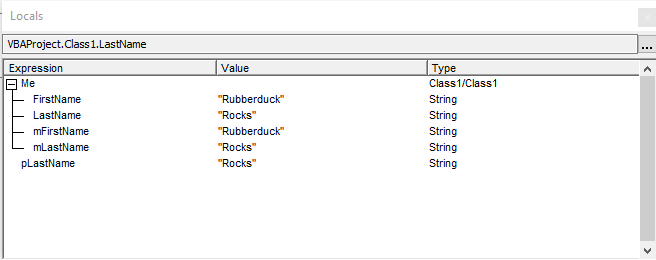
  • The locals debugging toolwindow becomes cluttered with all the private fields duplicating the Property Get membersvalues.
mFields-locals
The Locals toolwindow, showing fields and properties as members of Me.

With my “anti-pattern”, there’s a little bit more code, yes. But:

  • Properties and their respective backing field consistently use the same identifier. IntelliSense / autocomplete for my fields consistently only ever includes the backing fields, and all I had to do was to type this..
  • No need for any Hungarian prefix anywhere. I use T for the type declaration (I also use I for interfaces, like in .NET and most C-based languages), because I find that using the class identifier (which would be perfectly legal) would be potentially confusing in Private this As Class1, since in any other context (outside the class module itself) the identifier Class1 in an As clause would be referring to the Class1 class.
  • Parameter names are always explicitly passed ByVal and named value. Yes, this makes Range.Value show up as Range.value, but VBA being case-insensitive, it makes no difference whatsoever. I could have used any other identifier, but value is what VB.NET and C# use; besides RHS isn’t quite as sexy, if more semantically correct. But naming parameters after the property member is an objectively horrible idea; all you see is a soup of mFoo, pFoo and Foo with assignment operators in between.
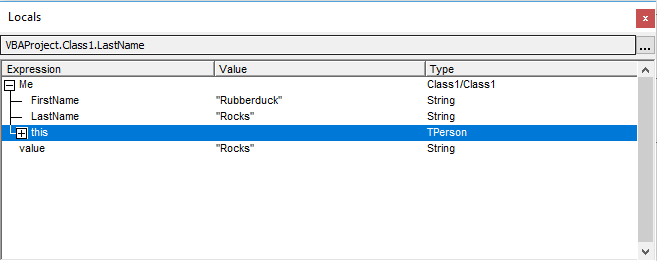
  • The locals debugging toolwindow now nicely regroups all the fields under this, so the object’s state is much easier to browse and understand at a glance.
  • If you ever need to serialize an object’s state to a binary file, then all you need to do is to Put #fileHandle this and you’re done. The inverse process is just as simple: no need to enumerate the properties one by one, convert them, or manipulate them in any way.
TPerson-locals
The Locals toolwindow, showing properties as members of Me, and a collapsed this member encapsulating the otherwise redundant fields.

I’d love to hear exactly what’s wrong with this “anti-pattern” of mine – I’ve grown pretty fond of it in the past couple years, and until someone can show me how and why I’m actively hurting something somewhere with it, I’ll keep using it in my own code, and posting Code Review and Stack Overflow answers featuring it.. and my blog posts will keep using it too.

One concern raised, was that a UDT doesn’t play well with collections. But this UDT isn’t going to end up in a collection anytime soon – and even if the class instance went into a collection, the encapsulated UDT couldn’t care less: all it does is regrouping the class’ internal state. Code outside the class doesn’t know about it, and couldn’t if it wanted.

You might be worried that a UDT incurs additional overhead… but it doesn’t: it simply provides a convenient structure to organize the private fields of a class. Two Long private fields allocate 4 bytes each and total 8 bytes; a UDT with two Long members allocates a total of 8 bytes, as Len(this) shows. What’s an easy way to know how much space the instance fields of a class take up?

Rubberduck has an encapsulate field refactoring that makes a public field private, renames it, and introduces Property Get and appropriate Property Let/Set mutators for it.

For a while I’ve been considering implementing a feature that builds on this Private Type [anti?] pattern, but held back because I didn’t want Rubberduck to enforce my coding style… although… I would love to be able to just declare my private type and my this private field, parse, and then right-click the UDT field and have Rubberduck generate all the Property Get/Let/Set boilerplate for me.

Would that make it more compelling?

Factories: Parameterized Object Initialization

Creating objects is something we do all the time. When we Set foo = New Something, we create a new instance of the Something class and assign that object reference to the foo variable, which would have been declared locally with Dim foo As Something.

With New

Often, you wish to instantiate Something with initial values for its properties – might look like this:

Dim foo As Something
Set foo = New Something
With foo
    .Bar = 42
    .Ducky = "Quack"
    '...
End With

Or, you could be fancy and make Something have a Self property that returns, well, the instance itself, like this:

Public Property Get Self() As Something
    Set Self = Me
End Property

But why would we do that? Because then we can leverage the rather elegant With New syntax:

Dim foo As Something
With New Something
    .Bar = 42
    .Ducky = "Quack"
    '...
    Set foo = .Self
End With

The benefits are perhaps more apparent with a factory method:

Public Function NewSomething(ByVal initialBar As Long, ByVal initialDucky As String) As Something
    With New Something
        .Bar = initialBar
        .Ducky = initialDucky
        Set NewSomething = .Self
    End With
End Function

See, no local variable is needed here, the With block holds the object reference. If we weren’t passing that reference down the call stack by returning it to the caller, the End With would have terminated that object. Not everybody knows that a With block can own an object reference like this, using With New. Without the Self property, a local variable would be needed in order to be able to assign the return value, because a With block doesn’t provide a handle to the object reference it’s holding.

Now the calling code can do this:

Dim foo As Something
Set foo = Factories.NewSomething(42, "Quack")

Here the NewSomething function is located in a standard module (.bas) named Factories. The code would have also been legal without qualifying NewSomething with the module name, but if someone is maintaining that code without Rubberduck to tell them by merely clicking on the identifier, meh, too bad for them they’ll have to Shift+F2 (go to definition) on NewSomething and waste time and break their momentum navigating to the Factories module it’s defined in – or worse, looking it up in the Object Browser (F2).

Where to put it?

In other languages, objects can be created with a constructor. In VBA you can’t have that, so you use a factory method instead. Factories manufacture objects, they create things.

In my opinion, the single best place to put a factory method isn’t in a standard/procedural module though – it’s on the class itself. I want my calling code to look something like this:

Dim foo As Something
Set foo = Something.Create(42, "Quack")

Last thing I want is some “factory module” that exposes a method for creating instances of every class in my project. But how can we do this? The Create method can’t be invoked without an instance of the Something class, right? But what’s happening here, is that the instance is being automatically created by VBA; that instance is named after the class itself, and there’s a VB_Attribute in the class header that you need to tweak to activate it:

VERSION 1.0 CLASS
BEGIN
  MultiUse = -1  'True
END
Attribute VB_Name = "Something"      '#FunFact controlled by the "Name" property of the class module
Attribute VB_GlobalNameSpace = False '#FunFact VBA ignores this attribute
Attribute VB_Creatable = False       '#FunFact VBA ignores this attribute
Attribute VB_PredeclaredId = True    '<~ HERE!
Attribute VB_Exposed = False         '#FunFact controlled by the "Instancing" property of the class module

The attribute is VB_PredeclaredId, which is False by default. At a low level, each object instance has an ID; by toggling this attribute value, you tell VBA to pre-declare that ID… and that’s how you get what’s essentially a global-scope free-for-all instance of your object.

That can be a good thing… but as is often the case with forms (which also have a predeclared ID), storing state in that instance leads to needless bugs and complications.

Interfaces

The real problem is that we really have two interfaces here, and one of them (the factory) shouldn’t be able to access instance data… but it needs to be able to access the properties of the object it’s creating!

If only there was a way for a VBA class to present one interface to the outside world, and another to the Create factory method!

VERSION 1.0 CLASS
BEGIN
  MultiUse = -1  'True
END
Attribute VB_Name = "ISomething"
Attribute VB_GlobalNameSpace = False
Attribute VB_Creatable = False
Attribute VB_PredeclaredId = False
Attribute VB_Exposed = False
Option Explicit

Public Property Get Bar() As Long
End Property

Public Property Get Ducky() As String
End Property

This would be some ISomething class: an interface that the Something class will implement.

The Something class would look like this- Notice that it only exposes Property Get accessors, and that the Create method returns the object through the ISomething interface:

VERSION 1.0 CLASS
BEGIN
  MultiUse = -1  'True
END
Attribute VB_Name = "Something"
Attribute VB_GlobalNameSpace = False
Attribute VB_Creatable = False
Attribute VB_PredeclaredId = True
Attribute VB_Exposed = False
Option Explicit
Private Type TSomething
    Bar As Long
    Ducky As String
End Type

Private this As TSomething
Implements ISomething

Public Function Create(ByVal initialBar As Long, ByVal initialDucky As String) As ISomething
    With New Something
        .Bar = initialBar
        .Ducky = initialDucky
        Set Create = .Self
    End With
End Function

Public Property Get Self() As ISomething
    Set Self = Me
End Property

Public Property Get Bar() As Long
    Bar = this.Bar
End Property

Friend Property Let Bar(ByVal value As Long)
    this.Bar = value
End Property

Public Property Get Ducky() As String
    Ducky = this.Ducky
End Property

Friend Property Let Ducky(ByVal value As String)
    this.Ducky = value
End Property

Private Property Get ISomething_Bar() As Long
    ISomething_Bar = Bar
End Property

Private Property Get ISomething_Ducky() As String
    ISomething_Ducky = Ducky
End Property

The Friend properties would only be accessible within that project; if that’s not a concern then they could also be Public, doesn’t really matter – the calling code only really cares about the ISomething interface:

With Something.Create(42, "Quack")
    Debug.Print .Bar 'prints 42
    .Bar = 42 'illegal, member not on interface
End With

Here the calling scope is still tightly coupled with the Something class though. But if we had a factory interface…

VERSION 1.0 CLASS
BEGIN
  MultiUse = -1  'True
END
Attribute VB_Name = "ISomethingFactory"
Attribute VB_GlobalNameSpace = False
Attribute VB_Creatable = False
Attribute VB_PredeclaredId = False
Attribute VB_Exposed = False
Option Explicit

Public Function Create(ByVal initialBar As Long, ByVal initialDuck As String) As ISomething
End Function

…and made Something implement that interface…

Implements ISomething
Implements ISomethingFactory

Public Function Create(ByVal initialBar As Long, ByVal initialDucky As String) As ISomething
    With New Something
        .Bar = initialBar
        .Ducky = initialDucky
        Set Create = .Self
    End With
End Function

Private Function ISomethingFactory_Create(ByVal initialBar As Long, ByVal initialDucky As String) As ISomething
    Set ISomethingFactory_Create = Create(initialBar, initialDucky)
End Function

…now we basically have an abstract factory that we can pass around to everything that needs to create an instance of Something or, even cooler, of anything that implements the ISomething interface:

Option Explicit

Public Sub Main()
    Dim factory As ISomethingFactory
    Set factory = Something.Self
    With MyMacro.Create(factory)
        .Run
    End With
End Sub

Of course this is a contrived example. Imagine Something is rather some SqlDataService encapsulating some ADODB data access, and suddenly it’s possible to execute MyMacro.Run without hitting a database at all, by implementing the ISomething and ISomethingFactory interfaces in some FakeDataService class that unit tests can use to test-drive the logic without ever needing to hit a database.

A factory is a creational pattern that allows us to parameterize the creation of an object, and even abstract away the very concept of creating an instance of an object, so much that the concrete implementation we’re actually coding against, has no importance anymore – all that matters is the interface we’re using.

Using interfaces, we can segregate parts of our API into different “views” of the same object and, benefiting from coding conventions, achieve get-only properties that can only be assigned when the object is initialized by a factory method.

If you really want to work with a specific implementation, you can always couple your code with a specific Something – but if you stick to coding against interfaces, you’ll find that writing unit tests to validate your logic without testing your database connections, the SQL queries, the presence of the data in the database, the network connectivity, and all the other things that can go wrong, that you have no control over, and that you don’t need to cover in a unit test, …will be much easier.

The whole setup likely isn’t a necessity everywhere, but abstract factories, factory methods, and interfaces, remain useful tools that are good to have in one’s arsenal… and Rubberduck will eventually provide tooling to generate all that boilerplate code.

Sounds like fun? Help us do it!

Coming soon, in Rubberduck 2.2

The last “green” release was a couple of months ago already – time to take a step back, look at all we’ve done, and call it a “minor” update.

What’s up duck?

Functionality-wise, not much. Bug fixes, yes; this means fewer inspection false positives, fewer caching accidents, overall more stable usage. But this time some serious progress was also made in the COM & RCW management area, and Rubberduck 2.2 no longer crashes on exit, or leave a dangling host process, or brick the VBE on reload. Some components are still stubbornly refusing to properly release, so unload+reload is still a not-recommended thing to do, but doing so no longer causes access violations. Which is neat, because this particular problem had been plaguing Rubberduck since the early days of 2.0.

Source Control Disintegration

If you haven’t been following the project since v2.1 was released, you may be disappointed to learn that we are officially dropping the source control integration feature. Not saying it’ll never resurface, but the feature was never really stable, and rather than drain our limited resources on a nice but non-essential feature, we focused on the “core” stuff for now. So instead of keeping the half-baked, half-broken thing in place, we removed it – entirely, so there’s 0 chance any part of it interferes with anything else (there were hooks in place, handling parser state changes and some VBE events).

The “Export Project” functionality remains though, so you can still use your favorite source control provider (Git, SVN, Mercurial, etc.) – Rubberduck just isn’t providing a UI to wrap that provider’s functionality anymore.

Shiny & New

We have new inspections! Rubberduck can now tell you when a Case block is semantically unreachable. Or when For loops specify a redundant Step 1, or if you prefer having an explicit Step clause everywhere, it can tell you about that too. Another inspection warns about error-handling suppression (On Error Resume Next) that is never restored (On Error GoTo 0). If you’re unfortunate enough to encounter the thoroughly evil Def[Type] statements, you’ll be relieved to know that Rubberduck will now warn you about implicitly typed identifiers.

Code Metrics is an entirely new tool, that evaluates cyclomatic complexity and nesting levels of each method and module. The feature clearly needs some UI work (wink wink, nudge nudge, C#/WPF reader), and enhancement ideas are always welcome.

The unit test execution engine no longer invokes the host application. There’s a bit of black magic going on here, but to keep it simple, the unit testing feature now works in every single VBE host application.

But the most spectacular changes aren’t really tangible, user-facing things. We’ve streamlined settings, upgrated our grammars from Antlr4.3 to Antlr4.6 – which fixed a number of parser issues, including significant performance improvements when parsing long Boolean expressions; the IInspection interface was fine-tuned again, COM object references were removed in a number of critical places. If you have a fork of the project, you already know that we’ve split Rubberduck.dll into Rubberduck.Core.dll and Rubberduck.Main.dll, with the entry point and IoC configuration in ‘Main’.

Oh, I lied. One of the most spectacular changes is a tangible, user-facing thing. It’s just not exactly in the main code base, is all. Poor installer, always gets left behind.

Administrative Privileges no longer needed!

Since a couple of pre-release builds, the Rubberduck installer supports per-user installs that no longer require admin privs. This means Rubberduck can now be installed on a locked-down workstation, without requiring IT intervention! This revamped installer also detects and properly uninstalls a previous Rubberduck install (admin elevation would be required to uninstall a per-machine installation of a previous build though), so manually uninstalling through the control panel before upgrading, is no longer recommended/needed. Doesn’t hurt, but shouldn’t change anything, really.

The “installating / instructions” and “contributing / initial setup” wiki pages have been updated accordingly on GitHub.

This new installer no longer assumes Microsoft Office is present, and registers for both 32 and 64-bit host applications.


That’s it? What happened to the rest of 2.1.x?

I did say “minor update”, yeah? The previously announced roadmap for 2.1.x was too ambitious, and not much of it is shipping in this release. In fact, that roadmap should have said “2.x”… versioning is hard, okay? If we stuck to 2.1.x, then a v2.2 would have been moot, since by then we would have had much of 3.0 in place.

Anyway, 2.2 is a terrific improvement over 2.1, on many levels – and that can only mean one thing: that the current development cycle will inevitably lead to even more awesomeness!

RD2018

VBA Trap: Default Members

The key to writing clear, unambiguous code, is rather simple:

Do what you say; say what you do.

VBA has a number of features that make it easy to not even realize you’re writing code that doesn’t do what it says it does.

One of the reasons for that, is the existence of default members – under the guise of what appears to be simpler code, member calls are made implicitly.

If you know what’s going on, you’re probably fine. If you’re learning, or you’re just unfamiliar with the API you’re using, there’s a trap before your feet, and both run-time and compile-time errors waiting to happen.

Example

Consider this seemingly simple code:

myCollection.Add ActiveSheet.Cells(1, 1), ActiveSheet.Cells(1, 1)

It’s adding a Range object, using the String representation of Range.[_Default] as a key. That’s two very different things, done by two bits of identical code. Clearly that snippet does more than just what it claims to be doing.


Discovering Default Members

One of the first classes you might encounter, might be the Collection class. Bring up the Object Browser (F2) and find it in the VBA type library: you’ll notice a little blue dot next to the Item function’s icon:

Collection.Item

Whenever you encounter that blue dot in a list of members, you’ve found the default member of the class you’re looking at.

That’s why the Object Browser is your friend – even though it can list hidden members (that’s toggled via a somewhat hidden command buried the Object Browser‘s context menu), IntelliSense /autocomplete doesn’t tell you as much:

IntelliSense-Collection.Item

Rubberduck’s context-sensitive toolbar has an opportunity to display that information, however that wouldn’t help discovering default members:

rubberduck-collection-item.png

Until Rubberduck reinvents VBA IntelliSense, the Object Browser is all you’ve got.


What’s a Default Member anyway?

Any class can have a default member, and only one single member can be the default.

When a class has a default member, you can legally omit that member when working with an instance of that class.

In other words, myCollection.Item(1) is exactly the same as myCollection(1), except the latter is implicitly invoking the Item function, while the former is explicit about it.


Can my classes have a default member?

You too can make your own classes have a default member, by specifying a UserMemId attribute value of 0​ for that member.

Unfortunately only the Description attribute can be given a value (in the Object Browser, locate and right-click the member, select properties) without removing/exporting the module, editing the exported .cls file, and re-importing the class module into the VBA project.

An Item property that looks like this in the VBE:

Public Property Get Item(ByVal index As Long) As Variant
End Property

Might look like this once exported:

Public Property Get Item(ByVal index As Long) As Variant
Attribute Item.VB_Description = "Gets or sets the element at the specified index."
Attribute Item.VB_UserMemId = 0
End Property

It’s that VB_UserMemId member attribute that makes Item the default member of the class. The VB_Description member attribute determines the docstring that the Object Browser displays in its bottom panel, and that Rubberduck displays in its context-sensitive toolbar.

Whatever you do, DO NOT make a default member that returns an instance of the class it’s defined in. Unless you want to crash your host application as soon as the VBE tries to figure out what’s going on.


What’s Confusing About it?

There’s an open issue (now closed) detailing the challenges implicit default members pose. If you’re familiar with Excel.Range, you know how it’s pretty much impossible to tell exactly what’s going on when you invoke the Cells member (see Stack Overflow).

You may have encountered MSForms.ReturnBoolean before:

Private Sub ComboBox1_KeyPress(ByVal KeyAscii As MSForms.ReturnInteger)
If Not IsNumeric(Chr(KeyAscii)) Then KeyAscii = 0
End Sub

The reason you can assign KeyAscii = 0 and have any effect with that assignment (noticed it’s passed ByVal), is because MSForms.ReturnInteger is a class that has, you guessed it, a default member – compare with the equivalent explicit code:

Private Sub ComboBox1_KeyPress(ByVal KeyAscii As MSForms.ReturnInteger)
If Not IsNumeric(Chr(KeyAscii.Value)) Then KeyAscii.Value = 0
End Sub

And now everything makes better sense. Let’s look at common Excel VBA code:

Dim foo As Range
foo = Range("B12") ' default member Let = default member Get / error 91
Set foo = Range("B12") ' sets the object reference '...

If foo is a Range object that is already assigned with a valid object reference, it assigns foo.Value with whatever Range("B12").Value returns. If foo happened to be Nothing at that point, run-time error 91 would be raised. If we added the Set keyword to the assignment, we would now be assigning the actual object reference itself. Wait, there’s more.

Dim foo As Variant
Set foo = Range("B12") ' foo becomes Variant/Range
foo = Range("B12") ' Variant subtype is only known at run-time '...

If foo is a Variant, it assigns Range("B12").Value (given multiple cells e.g. Range("A1:B12").Value, foo becomes a 2D Variant array holding the values of every cell in the specified range), but if we add Set in front of the instruction, foo will happily hold a reference to the Range object itself. But what if foo has an explicit value type?

Dim foo As String
Set foo = Range("B12") ' object required
foo = Range("B12") ' default member Get and implicit type conversion '...

If foo is a String and the cell contains a #VALUE! error, a run-time error is raised because an error value can’t be coerced into a String …or any other type, for that matter. Since String isn’t an object type, sticking a Set in front of the assignment would give us an “object required” compile error.

Add to that, that Range is either a member of a global-scope object representing whichever worksheet is the ActiveSheet if the code is written in a standard module, or a member of the worksheet itself if the code is written in a worksheet module, and it becomes clear that this seemingly simple code is riddled with assumptions – and assumptions are usually nothing but bugs waiting to surface.

See, “simple” code really isn’t all that simple after all. Compare to a less naive / more defensive approach:

Dim foo As Variant foo = ActiveSheet.Range("B12").Value
If Not IsError(foo) Then
Dim bar As String
bar = CStr(foo) '...
End If

Now prepending a Set keyword to the foo assignment no longer makes any sense, since we know the intent is to get the .Value off the ActiveSheet. We’re reading the cell value into an explicit Variant and explicitly ensuring the Variant subtype isn’t Variant/Error before we go and explicitly convert the value into a String.

Write code that speaks for itself:

  • Avoid implicit default member calls
  • Avoid implicit global qualifiers (e.g. [ActiveSheet.]Range)
  • Avoid implicit type conversions from Variant subtypes

Bang (!) Operator

When the default member is a collection class with a String indexer, VBA allows you to use the Bang Operator ! to… implicitly access that indexer and completely obscure away the default member accesses:

Debug.Print myRecordset.Fields.Item("Field1").Value 'explicit
Debug.Print myRecordset!Field1 'all-implicit

Here we’re looking at ADODB.Recordset.Fields being the default member of ADODB.Recordset; that’s a collection class with an indexer that can take a String representing the field name. And since ADODB.Field has a default property, that too can be eliminated, making it easy to… completely lose track of what’s really going on.


Can Rubberduck help / Can I help Rubberduck?

As of this writing, Rubberduck has all the information it needs to issue inspection results as appropriate… assuming everything is early-bound (i.e. not written against Variant or Object, which means the types involved are only known to VBA at run-time).

In fact, there’s already an Excel-specific inspection addressing implicit ActiveSheet references, that would fire a result given an unqualified Range (or Cells, Rows, Columns, or Names) member call.

ImplicitActiveSheetReference

This inspection used to fire a result even when the code was written in a worksheet module, making it a half-lie: without Me. qualifying the call, Range("A1") in a worksheet module is actually implicitly referring to that worksheet…and changing the code to explicitly refer to ActiveSheet would actually change the behavior of the code. Rubberduck has since been updated to understand these implications.

Another inspection flagging implicit default member calls has also been implemented with a quick-fix to expand the default member call, and bang operators can now be expanded to full notation (in the entire project at once if you like) with a single click, and inspections can flag bang notation, unbound bang notation, recursive bang notation,

Let-assignments involving implicit type conversions are also something we need to look into. Help us do it! This inspection also implies resolving the type of the RHS expression – a capability we’re just barely starting to leverage.

If you’re curious about Rubberduck’s internals and/or would love to learn some serious C#, don’t hesitate to create an issue on our repository to ask anything about our code base; our team is more than happy to guide new contributors in every area!